A bottle of oil tells only a small part of the argan tree’s story. In southwest Morocco, the tree, fruit collection, preparation, tools and culinary or social uses form a connected body of practices passed through communities.
In 2014 UNESCO inscribed “Argan, practices and know-how concerning the argan tree” on the Representative List of the Intangible Cultural Heritage of Humanity. The inscribed element is neither a brand nor one recipe: it connects a territory, people and a sequence of skills.
A tree rooted in southwest Morocco
The argan tree is an endemic woodland species found in the Arganeraie Biosphere Reserve. Its landscape is not a uniform plantation. It combines trees, grazing, agriculture and local uses in a balance shaped by the territory.
For travellers, recognising that setting prevents “argan” from becoming a generic marketing word. A product sold far from the region does not by itself prove the origin of the fruit or how value is shared.
A precise sequence of tasks
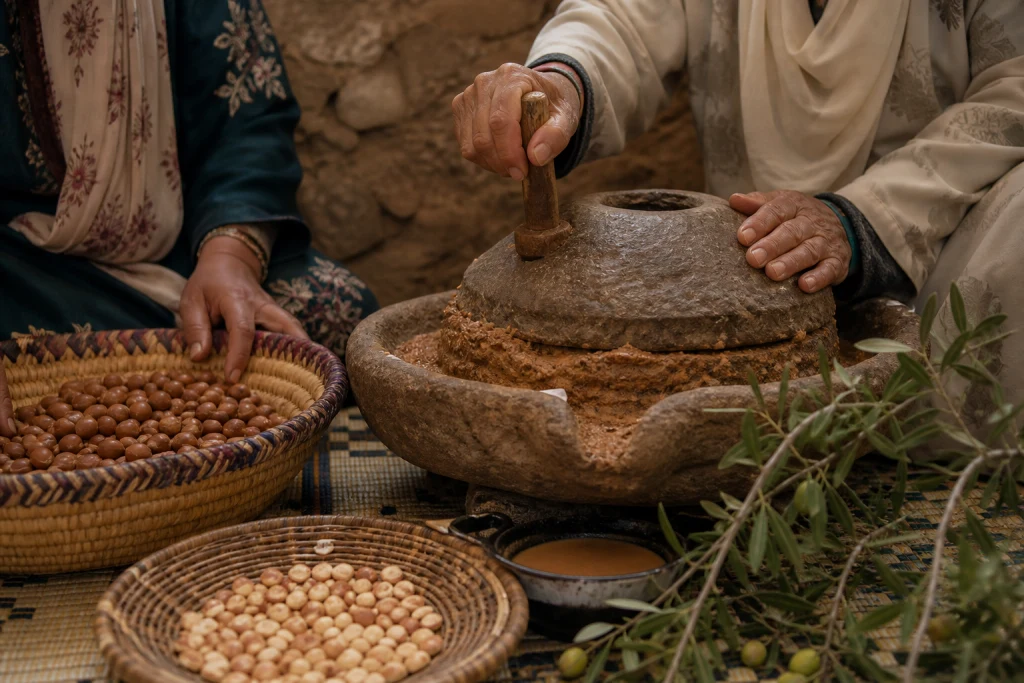
UNESCO’s record describes harvesting, drying, pulping, grinding, sorting, milling and mixing. Some operations require a particular hand mill, itself made by local craftspeople.
This sequence explains why a demonstration lasting a few minutes cannot represent the whole process. It may show one gesture, but responsible interpretation states what was prepared beforehand, what follows and who holds the relevant knowledge.
Transmission led mainly by women
Traditional methods are practised by rural women and, to a lesser extent, by men living in the reserve. Learning takes place in part through imitation and non-formal education.
The phrase “women’s cooperative” does not on its own establish how an organisation is governed. A responsible visit asks how producers take part in decisions, how work is paid and whether the account presented comes from the women themselves.
Uses that extend beyond cosmetics
Argan oil is used in food, preparations and cosmetics. UNESCO also notes its place in ceremonial dishes and as a wedding gift. These functions connect the product to social life.
MOP avoids medical promises. Cultural heritage is not clinical evidence, and a seller should not turn tradition into an unsupported health claim. For food or cosmetic use, the product label and safety directions take priority.
Observe a workshop without staging people
Ask before photographing hands, a face, an interior or a tool. Permission to observe does not automatically grant permission to publish an image. Avoid asking someone to repeat a gesture only to produce a picture.
Good interpretation leaves time for explanation: where the fruit comes from, which stages take place on site, what tools are used, how food and cosmetic oils differ, how work is organised and what traceability is available.
Ask simple questions before buying
Check the producer or organisation name, address, stated use, ingredient list, volume and packaging. Food oil and a cosmetic product are not interchangeable. Be cautious with packages that provide no information or stories based only on the word “natural”.
The lowest price may hide the complexity of the work; the highest does not guarantee fairer distribution. Ask what the purchase supports and prefer a precise answer to a perfect marketing story.
Connect the product to the landscape
A stop in the argan landscape is more meaningful when it explains the relationship between tree, soil, pastoral use and processing. Do not collect fruit or leave authorised tracks to take a photograph.
On a route between Essaouira, Agadir or Taroudant, treat a workshop visit as a distinct period. It should not be a compulsory sales stop hidden inside an excursion without advance information.
Reference points for a fair visit
- Understand that the UNESCO element covers practices, not a brand.
- Ask where the fruit comes from and which steps occur on site.
- Obtain consent before any photograph.
- Distinguish food products from cosmetics.
- Reject undocumented medical claims.
- Check producer identity and labelling.
- Choose a visit that explains pay and governance.
Sources consulted
- UNESCO, “Argan, practices and know-how concerning the argan tree”, accessed 29 August 2026: official English record
- UNESCO, “L’argan, pratiques et savoir-faire liés à l’arganier”, accessed 29 August 2026: official French record
- UNESCO, Intangible Cultural Heritage country page for Morocco, accessed 29 August 2026: institutional inventory