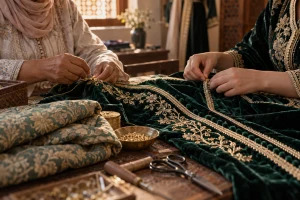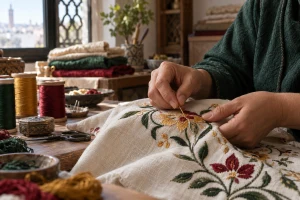
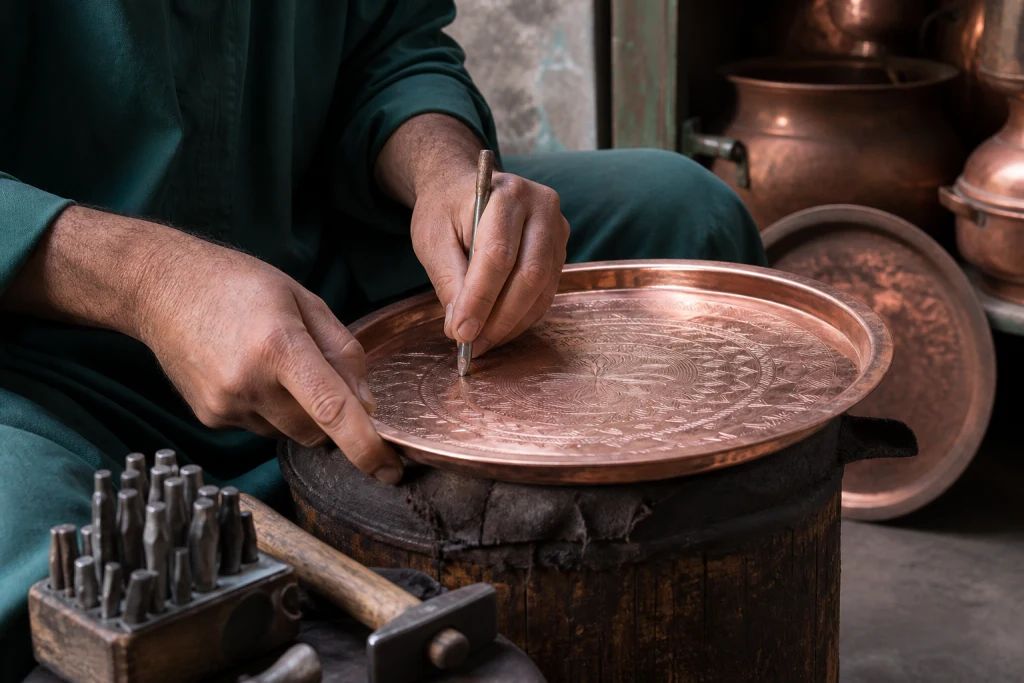
An engraved tray first attracts attention through reflected light. Yet Moroccan metalworking known as dinanderie is more than a bright surface. The ministry responsible for crafts describes a field working with copper, bronze, brass and sometimes nickel silver to make utensils, lighting, architectural elements and decorative objects.
MOP suggests slowing the gaze: identify the stated material, understand the visible stages and ask who actually performed the work. This helps distinguish a short demonstration, a finishing operation and the complete making of an object.
What dinanderie includes
The ministry’s panorama distinguishes architectural and lighting metalwork from utensils. Lanterns, door knockers, door coverings, teapots, mortars, candlesticks, ewers and trays do not require exactly the same shaping or assembly.
Fez, Marrakesh, Rabat, Meknes and Tetouan are among the centres named, while practices exist in other cities. An object cannot be assigned to a particular city from its pattern alone.
Read the stages, not one isolated gesture
Depending on the object, work may include marking, cutting, shaping, hammering, engraving, assembly, polishing and surface treatment. A demonstration lasting a few minutes usually shows only one stage.
Ask what was completed in the workshop, what arrived prepared and how many people contributed. A precise answer is more useful than a story attributing the entire object to the gesture happening in front of a visitor.
Distinguish the stated materials
Copper, brass, bronze and nickel silver have different compositions and appearances. A silver- or gold-coloured finish does not reveal the metal beneath it. Weight alone does not prove origin or quality either.
Before buying, ask for the main material, surface treatment and intended use. For an item expected to touch food or drink, look for suitable labelling and product information instead of relying only on a spoken assurance.
Understand that quality is controlled
The ministry reports developing standards for several craft sectors and names the metal teapot among products covered by mandatory standards connected to consumer health and safety.
This does not mean that every object for sale automatically carries certification. Ask for the producer, product reference, intended use and, when a label is claimed, the exact mark that allows it to be checked.
Observe without disrupting work
A workshop may contain sharp tools, hammers, dust and operations involving heat or surface treatment. Remain in the indicated area and do not touch an object, metal offcut or tool without permission.
Ask before photographing a person, their hands, a work in progress or the workshop interior. Permission to enter is not permission to publish. Avoid requesting that a craftsperson repeat a movement simply to create a more dramatic picture.
Ask questions that reveal the value chain
Who drew the pattern? Who shaped the piece? Who engraved and polished it? Does the workshop accept commissions? These questions reveal roles often hidden by the broad phrase “handmade”.
Several specialists may contribute to a complex piece. Collaboration does not reduce its craft value when the process is explained and the origin is not invented.
Buy without searching for perfect proof
An irregularity may show manual work, but it does not guarantee the material, provenance or fair pay. A regular surface does not automatically establish industrial production either.
Request a receipt identifying the seller, description, stated material and price. For an object intended for air travel, check dimensions, packaging and baggage rules before paying.
Connect tradition and innovation
The national tourism office notes that copperware now includes both traditional forms and contemporary versions. Innovation may affect design, function, assembly or finish without erasing the underlying skill.
The ministry also mentions research into improved processes and surface treatment. Presenting tradition as motionless would therefore miss an essential part of the subject: craftspeople adapt tools, standards and uses while transmitting knowledge.
Reference points for an attentive visit
- Ask about the material and intended use.
- Identify which stages were completed on site.
- Do not infer a city of origin from a pattern alone.
- Check a label or standard through a precise mark.
- Obtain permission before taking any photograph.
- Stay outside marked work areas.
- Request a descriptive receipt for an important purchase.
- Recognise the different craftspeople contributing to the piece.
Sources consulted
- Ministry of Tourism, Handicrafts and Social and Solidarity Economy, “Panorama de l’artisanat — Dinanderie”, accessed 31 August 2026: institutional document in French
- Ministry of Tourism, Handicrafts and Social and Solidarity Economy, “Qualité et innovation”, accessed 31 August 2026: standards and processes in French
- Moroccan National Tourist Office, “Moroccan traditional craftsmanship revisited”, accessed 31 August 2026: official copperware presentation