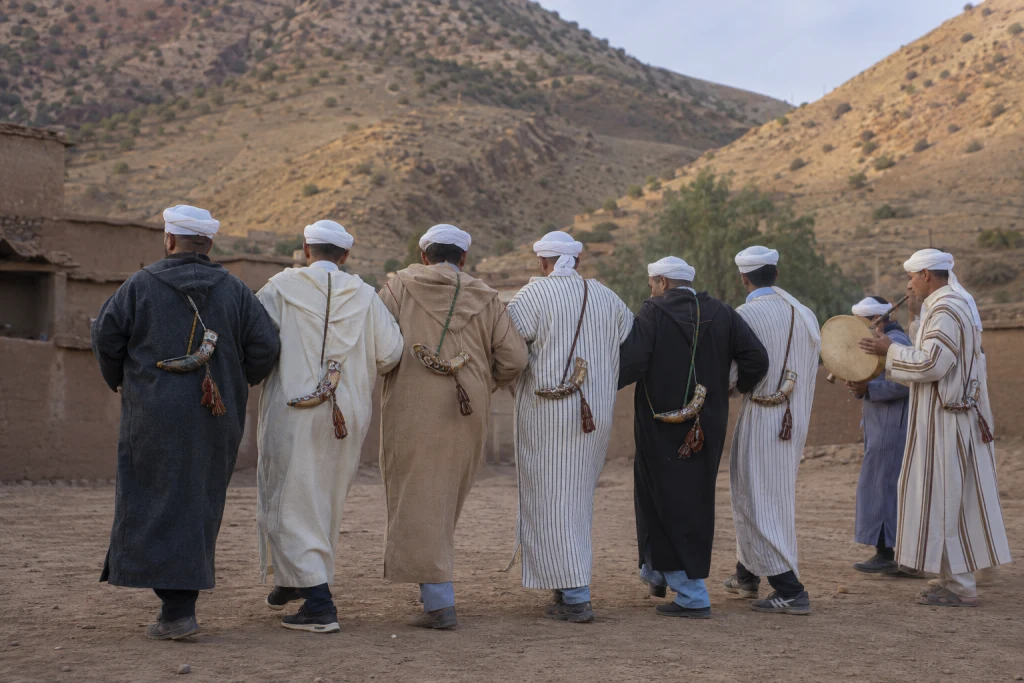
Taskiwin is a martial dance of Morocco’s western High Atlas. UNESCO explains that its name comes from the Tiskt, a richly decorated horn carried by each dancer. Shoulder movement follows the rhythm of tambourines and flutes. The practice supports social cohesion and gives young people an important form of socialisation.
It was inscribed in 2017 on the List of Intangible Cultural Heritage in Need of Urgent Safeguarding. The status does not identify a daily show or an attraction ready to book. It signals that a living practice, its bearers and associated skills need real conditions for transmission.
A dance rooted in the western High Atlas
UNESCO documentation locates Taskiwin in the western High Atlas. An earlier assistance project names the Touramat and Tigouliane rural communities in Taroudant Province on the northern and southern slopes of the range.
That location does not turn every village into a public stage. The practice belongs to communities and particular occasions. A visitor should verify whether a presentation has been announced, who is organising it and whether attendance is appropriate.
The Tiskt gives the practice its name
The Tiskt is described as a decorated horn carried by a dancer. It belongs to a larger system in which object, clothing, music and movement interact. Treating it as a photogenic accessory removes its relationship to collective motion and identity.
Do not handle a Tiskt or instrument without invitation. When considering a contemporary purchase, ask about material, maker, use and origin. A decorative reproduction should not be sold as an old object or as a piece carried by a named group without evidence.
Shoulders, rhythm and formation
UNESCO describes shoulder movement supported by tambourines and flutes. Nomination photographs show several collective formations, including lines and circles. Precision comes from coordination, not from a solo isolated for a camera.
Watching therefore takes time. Observe the entrance, the relationship between musicians and dancers and changes in the formation. Do not interpret every movement as a literal battle: the practice is artistic, social and historical.
Why safeguarding is urgent
UNESCO’s file says the dance has become limited to a small number of villages. It cites declining interest among some younger people, difficulty finding apprentices and reduced craft production for instruments and accessories.
An Urgent Safeguarding listing does not announce inevitable disappearance. It recognises vulnerability and creates a framework for monitoring action. Morocco submitted a report in December 2025 for examination in 2026; because no public summary is available yet, MOP does not invent an outcome.
Transmission is larger than a stage
Learning often occurs informally through observation, participation and direct relationships. A performance can make the practice visible, but it does not replace rehearsals, artisans, associations or the decisions of communities to continue.
The file notes greater collective awareness and the creation of dedicated associations. Supporting continuity means identifying organisers and paying transparently when a performance is offered, without demanding a shortened or more spectacular version.
Photograph without directing the practice
Ask before photographing, particularly for a portrait, child, accessory or backstage area. A public event does not automatically provide unlimited permission over each person. Avoid flash, standing inside the formation or asking performers to repeat a gesture.
Do not invent a caption about tribe, rank or an object’s meaning. If nobody explained the context, describe only what can be verified. A wider frame may respect the collective nature better than an isolated face.
Separate safeguarding from folklorisation
Safeguarding allows a practice to be transmitted and recreated by the people concerned. Folklorisation often freezes it into an allegedly old image, removes names and adapts movement only to an audience’s expectations.
A contemporary form is not automatically less authentic. Bearers may choose new venues, clothing, formats or teaching methods. A visitor’s role is to hear those explanations, not to select the version that best matches an ideal photograph.
Prepare for an announced encounter
Verify the programme, venue, time, access and organiser through a recent source. Ask whether the event is public, whether a contribution is expected and what image rules apply. Never build a mountain journey around an old poster.
Plan transport, a return before night and an alternative as well. MOP publishes no recurring date or ticket without active evidence. The rarity of an occasion never authorises an unverifiable promise.
What Taskiwin invites us to see
Taskiwin links movement, sound, objects, artisans, villages and transmission between generations. That chain explains its significance. The visible Tiskt is an entry point into a system of relationships rather than the whole story.
The strongest account names the practice accurately, credits its bearers when they wish and explains safeguarding without declaring disappearance. Discovering with context means allowing the community to remain the subject of its own heritage.