Morocco will co-host the 2030 World Cup.
A simple sentence… but a momentous event.
Because the World Cup is more than a tournament.
It is a moment when the entire planet watches the host countries.
It is a showcase of soft power.
It is an infrastructure accelerator.
It is a tourism boost.
It is a source of national pride.
And in 2030, the event is even more symbolic:
the World Cup celebrates its centenary (1930 → 2030).
In this ultra-comprehensive feature, you will discover:
- the key dates (FIFA, decisions, schedule),
- the figures (airports, stadiums, tourism, investments),
- the Moroccan cities at the heart of the project,
- the expected economic and social impacts,
- and why this is a historic moment for Morocco.
📌 Key figures & dates to remember (in 30 seconds)
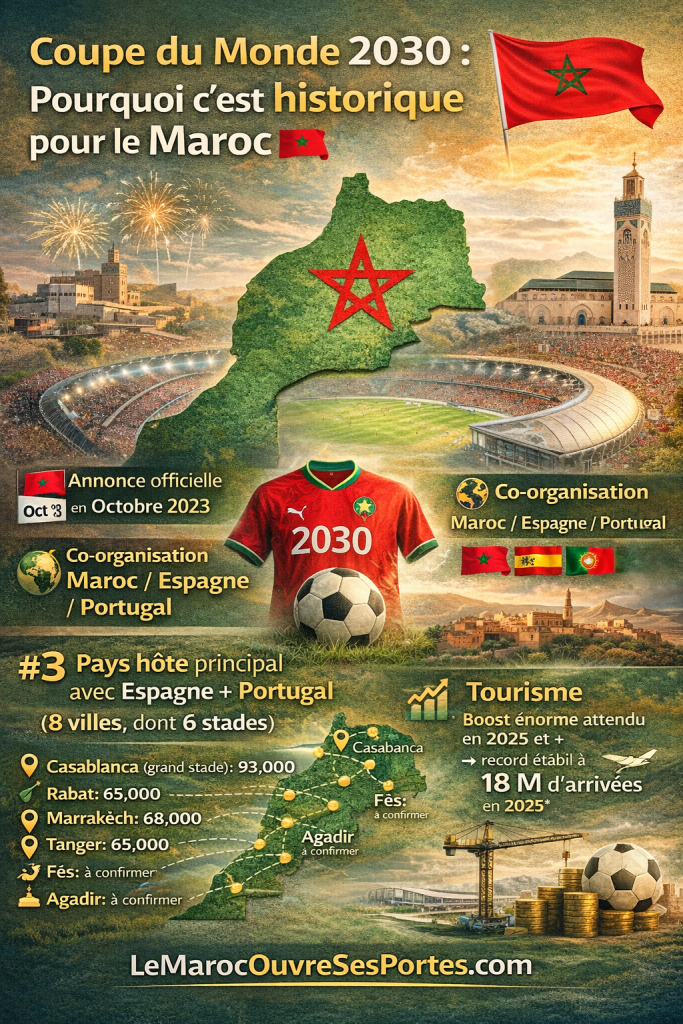
✅ 4 October 2023: the FIFA Council selects the Morocco–Spain–Portugal bid as the “sole bid” (subject to the final process).
✅ 11 December 2024: the Extraordinary FIFA Congress officially appoints Morocco, Spain and Portugal as host countries (with 3 “centenary” matches in Uruguay, Argentina and Paraguay).
✅ 2030: centenary of the World Cup (1930 → 2030).
✅ Airports: Morocco’s target is 80 million passengers by 2030 (compared with ~38 million), with a plan announced at 38 billion dirhams.
✅ Financing: the AfDB approves a loan of €270M (≈$316M) to modernise airports with 2030 in mind.
✅ Major stadium: a stadium project near Casablanca (Benslimane) has been announced with 115,000 seats and a cost of around 5 billion dirhams, with a delivery target mentioned around 2027/2028 according to public statements and the press.
1) Why “2030” is a special year: the centenary World Cup
The FIFA World Cup began in 1930.
In 2030, it therefore celebrates its 100th anniversary.
To celebrate this centenary, the 2030 edition has an exceptional format:
- The “heart” of the tournament is co-hosted by Morocco – Spain – Portugal.
- And three opening/commemorative matches (“centenary celebration matches”) are planned in Uruguay, Argentina and Paraguay (one match in each country).
This format tells a story:
1930 begins in South America.
2030 celebrates that beginning… then places Africa (Morocco) at the centre of the main event.
2) Official timeline: key dates of the 2030 World Cup
| Year / Date | What happens | Why it matters |
|---|---|---|
| 1930 | First World Cup (Uruguay) | Historic starting point of the “centenary” |
| 7 Oct. 2020 | Spain & Portugal announce their intention to submit a joint bid (initial phase) | Beginning of a structured Iberian initiative |
| 14 March 2023 | Morocco officially joins the Morocco–Spain–Portugal project | Birth of an intercontinental Africa–Europe bid |
| 4 Oct. 2023 | The FIFA Council selects the proposal as the “sole bid” for 2030 | Decisive step: the project becomes the main path |
| 11 Dec. 2024 | Extraordinary FIFA Congress: Morocco–Spain–Portugal officially appointed as hosts | Final approval, historic for Morocco |
| June–July 2030 | Planned tournament period (broad window according to public sources) | Organisation window, preparation of transport & accommodation |
3) Why it is historic for Morocco: 10 compelling reasons
Here are 10 reasons (clear and concrete) that explain why 2030 is a turning point:
- First World Cup held in Africa since 2010: Morocco puts Africa back at the heart of world football.
- First World Cup in Morocco: a major national symbol.
- A centenary: the 2030 edition will remain in the history books.
- An Africa–Europe bridge: rare, powerful and highly publicised.
- An infrastructure accelerator: stadiums, roads, rail and airports.
- A massive tourism boost: before, during and after.
- A global showcase: culture, identity, hospitality and the country’s image.
- An economic opportunity: investments, jobs, contracts and services.
- A lasting legacy: reused facilities and long-term modernisation.
- Popular pride: the event strengthens unity and collective enthusiasm.
4) Morocco before 2030: a country already building momentum around “major events”
The World Cup is not coming to a “beginner” country.
Morocco already has:
- a strong and growing tourism sector,
- major infrastructure (high-speed rail, motorways and air hubs),
- major existing stadiums that can be modernised,
- and experience in international hosting (events, sport and conferences).
Above all, Morocco gained global sporting visibility after 2022:
the national team’s performance made a lasting impression…
and increased international attention on the Kingdom.
5) Economic impact: where is value created? (simple explanation + figures)
A World Cup triggers spending and investment in:
- construction and public works (stadiums, roads and urban renovation),
- transport (airports, railway stations and mobility),
- hospitality (new capacity),
- services (catering, security and events),
- digital services (ticketing, payments, apps and data).
Morocco has already announced major areas of modernisation.
5.1 Airports: the figure that speaks to everyone
Target: increase the capacity of Moroccan airports to 80 million passengers by 2030.
Publicly stated starting point: around 38 million.
Announced plan amount: around 38 billion dirhams (overall plan, preparations for 2030 and tourism momentum).
And this plan was strengthened by:
- a government–ONDA (airports) agreement mentioning 25 billion dirhams for expansion + 13 billion for maintenance & land (announcement reported by the press).
- AfDB financing: €270M (≈$316M) to modernise airport infrastructure.
6) Tourism impact: Morocco in the global spotlight
Tourism is one of the major beneficiaries of a World Cup.
Why?
Because millions of people discover the country…
and then return, sometimes years later.
6.1 A very telling indicator: recent tourism record
Morocco broke a tourist arrival record (announcement reported by the press) with:
- 18 million arrivals by the end of November 2025 (announced record).
This figure is important:
it shows that the country is already on a trajectory of growing appeal…
even before the World Cup effect.
6.2 What 2030 will change for travellers
- more flights,
- more accommodation,
- more intercity connections,
- more digital services,
- and an incomparable atmosphere in the host cities.
7) Host cities in Morocco: where will the event take place?
Morocco has several major cities capable of hosting:
- matches,
- fan zones,
- delegations,
- and hundreds of thousands of visitors.
The exact list may change depending on final approvals.
But the Moroccan cities regularly cited as pillars of the project include:
- Casablanca (economic metropolis, major stadium project),
- Rabat (capital, renovations),
- Tangier (gateway to the North, strong infrastructure),
- Marrakech (global tourism),
- Agadir (coastal tourism capacity),
- Fez (heritage, identity and cultural appeal).
8) Stadiums & major projects: what is being prepared in concrete terms
Morocco is preparing for 2030 through:
- the renovation / upgrading of existing stadiums,
- the modernisation of access routes (roads and transport),
- and a “showcase” stadium project near Casablanca.
8.1 The giant stadium near Casablanca: the symbol
A very large stadium project near Casablanca (Benslimane) has been announced with:
- 115,000 seats (projected capacity),
- an announced cost of ≈ 5 billion dirhams,
- a delivery target mentioned around 2027/2028 according to public statements and the press.
This stadium could become:
- a “showcase” stadium for Morocco,
- a natural candidate for a very high-profile match,
- and a major legacy for the post-2030 period.
9) Timeline of Moroccan investments, 2024 → 2030 (infrastructure & preparation)
Here is a clear timeline with the public milestones most frequently cited in the press and institutional announcements.
| Year | Investments / projects | Figures & milestones |
|---|---|---|
| 2024 | Official approval of host country + accelerated preparation | 11 Dec. 2024: official appointment of Morocco–Spain–Portugal as hosts |
| 2025 | Airports (national plan) + financing & agreements | Reported airport agreement: MAD 25bn for expansion + MAD 13bn for maintenance/land; AfDB: €270M for upgrades |
| 2026 | Ramp-up of construction projects (stadiums, access and services) | Strengthening logistics, hospitality and digitalisation (milestones vary by city) |
| 2027 | Interim delivery targets | Press: giant stadium near Casablanca said to be “ready around 2027” (according to reported statements) |
| 2028 | Final FIFA compliance phase (stadiums & operations) | Public sources: 2028 target for completion of the major stadium (according to announced projects) |
| 2029 | Full-scale testing (events, flows, security and fan zones) | Dress-rehearsal year: transport, hospitality and operations |
| 2030 | World Cup + airport target | Target: airport capacity of 80M passengers; tournament in June–July 2030 |
Note: the amounts by city/stadium may change as announcements are made. This timeline provides the reader with a clear guide.
10) Expected impacts: tourism, employment, cities and image
10.1 Employment: why preparation creates opportunities
A World Cup creates activity in:
- construction and public works (construction, renovation and maintenance),
- transport (airports, rail and urban transport),
- hotels and restaurants,
- events, security and logistics,
- digital services (payments, platforms and content).
10.2 The cities: what residents gain
- improved infrastructure,
- modernised urban spaces,
- greater appeal,
- a legacy that remains after 2030.
10.3 Image & soft power: a global showcase
During a World Cup, the cameras show:
- the stadiums,
- the streets,
- the landscapes,
- the people,
- the culture.
And this is where Morocco is formidable:
hospitality, cuisine, beautiful cities and diverse regions…
11) Practical tables: trip planning & quick overview
11.1 Moroccan cities: “why go there?”
| City | Why it is strategic | Suggested experiences |
|---|---|---|
| Casablanca | Metropolis, hubs, major facilities and hotel capacity | Hassan II Mosque, corniche, city tour and cuisine |
| Rabat | Capital, official events and cultural sites | Kasbah of the Udayas, Hassan Tower and museums |
| Tangier | Gateway to the North, access to Europe and tourism momentum | Cap Spartel, Caves of Hercules, medina and Asilah (nearby) |
| Marrakech | Global destination, accommodation capacity and excursions | Jemaa el-Fna, gardens, Atlas Mountains and desert (2–3 days) |
| Agadir | Coastal destination, large tourist flows and mild climate | Beaches, surfing, Taghazout and Paradise Valley |
| Fez | Heritage, cultural tourism and authenticity | Medina, tanneries, crafts and cuisine |
11.2 “2030 World Cup trip” checklist (ultra-useful)
- Book early: flights + accommodation
- Choose a base city and explore the surrounding area (train, excursions)
- Plan a “match + transport + activities” budget
- Plan connectivity in advance (eSIM, data plan)
- Add 2–3 days without matches (Atlas Mountains, desert, sea)
12) FAQ — Everything people will search for on Google
✅ Is Morocco really hosting the 2030 World Cup?
Yes. The Extraordinary FIFA Congress officially appointed Morocco, Spain and Portugal as host countries, with three “centenary” matches in Uruguay, Argentina and Paraguay.
✅ Why is it described as historic?
Because 2030 is the centenary edition, and because Morocco is becoming a host country for a global event with enormous sporting, economic, tourism and cultural significance.
✅ Which cities in Morocco will host matches?
The exact cities and stadiums may change depending on final approvals, but Casablanca, Rabat, Tangier, Marrakech, Agadir and Fez are regularly cited as key cities.
✅ What is Morocco’s largest stadium project for 2030?
A major stadium project near Casablanca (Benslimane) has been announced with around 115,000 seats and a cost of ~5 billion dirhams, with a 2027/2028 delivery target mentioned according to public sources.
✅ What major investments have been announced?
The most significant announcements notably concern airports (target of 80M passengers by 2030, plan announced at MAD 38bn, ONDA agreements and an AfDB loan of €270M for upgrades).
13) Conclusion: 2030, Morocco enters history
The 2030 World Cup represents:
- a powerful national symbol,
- accelerated infrastructure development,
- a global showcase,
- and a lasting legacy.
Morocco will not only host matches.
It will host the world.
Morocco Opens Its Doors… and in 2030, it will open them to the entire planet 🌍🇲🇦⚽
- 🏨 Accommodation: hotels, riads, apartments (book early)
- 🚆 Transport: train tickets, shuttles, city passes
- 📶 Connectivity: Morocco eSIM / data plan
- 🧭 Activities: Atlas excursions, desert trips, guided tours
- 🧳 Accessories: cabin bag, adapter, power bank