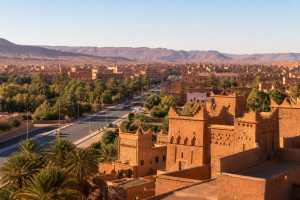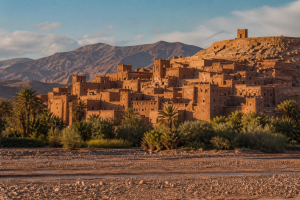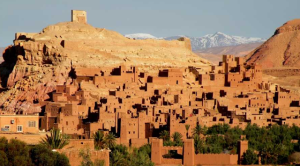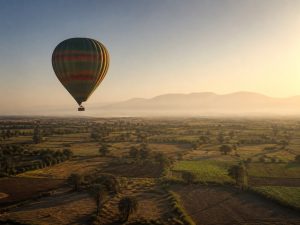
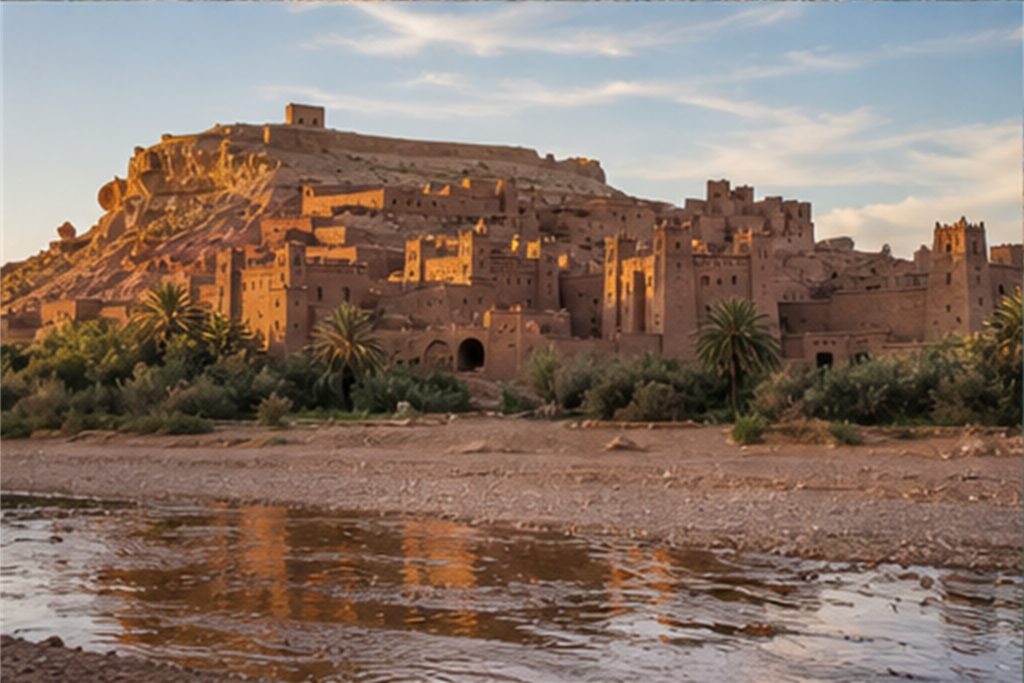
The ksar of Aït-Ben-Haddou has been listed as a World Heritage Site since 1987. This group of earthen dwellings, surrounded by walls and reinforced with towers, illustrates the pre-Saharan architecture of southern Morocco. Its silhouette has also served as the backdrop for many film shoots, sometimes to the point of eclipsing its own history.
The site is neither a frozen castle nor an abandoned studio. Some families still live there, the materials require constant maintenance and visitor numbers put pressure on it. A respectful visit begins with this reality.
Understanding what a ksar is
A ksar is a fortified group settlement. At Aït-Ben-Haddou, the rammed-earth buildings are arranged inside an enclosure, with houses, passageways, communal spaces and decorated buildings. The term kasbah generally refers to a fortified residence or a seat of power, not the entire village.
UNESCO highlights the value of this example of southern Moroccan architecture and the use of earth-based techniques. These materials blend into the landscape but remain vulnerable to water, erosion and unsuitable repairs.
Viewing the walls as a living technology changes the visit: thickness, drainage, rendering and maintenance become as important as the decorative motifs.
Getting to Aït-Ben-Haddou
The ksar is located in Ouarzazate Province, away from the main road. From Ouarzazate, you can make the return journey by taxi, car or excursion. Agree on the price, waiting time and pick-up point.
From Marrakech, the road crosses the High Atlas and may be affected by weather, roadworks or traffic. A day trip involves many hours in a vehicle. Spending a night in Ouarzazate or near the ksar allows for a safer pace.
Consult our guide to driving in Moroccoand check the road conditions that same morning. Do not impose an unrealistic schedule on the driver.
Choosing the time and season
Morning and late afternoon offer soft light and more bearable temperatures. In summer, the middle of the day can be gruelling. In winter, shade and wind make a warm layer useful.
The river crossing and access routes may vary with rainfall. Use the designated paths and follow local guidance. Do not cross flowing water simply because other visitors are doing so.
Arriving early or sleeping nearby reduces exposure to concentrated tour groups. This does not give you the right to enter a private space: the same rules apply at all times.
Climbing through the ksar
The lanes and stairs are uneven. Wear sturdy footwear and keep your hands free. The climb to the higher areas offers a panoramic view, but the wind and unprotected edges require caution.
Stay on open passageways. A half-open door is not an invitation. Some residents offer visits to a house or space for payment: ask the price beforehand and respect the designated areas.
Do not climb on an earthen wall or lean against fragile decoration. The erosion caused by one visitor may seem minimal, but it is repeated thousands of times.
Understanding the architecture with a guide
A local guide can distinguish between a granary, tower, lane, house and communal space. Ask about their status, the duration and the price. An explanation should distinguish documented history, family memory and filming anecdotes.
Cinema can serve as an entry point, but it should not turn every building into a film set attributed without evidence. Instead, ask about temporary adaptations and how film shoots have affected the local economy and the site’s image.
A small group speaks more quietly, blocks fewer passageways and allows more questions. Loudspeakers have no place in inhabited lanes.
Taking photographs without staging residents
Ask for permission before taking any portrait. Buying a souvenir or paying an admission fee does not grant a general right to someone’s image. For a child, permission from a responsible adult is essential.
Avoid moving an object, opening a door or asking someone to re-enact an activity. Documentary photography respects what is actually happening.
Drones are subject to strict rules in Morocco and may disturb residents and visitors. Do not bring one without permits verified with the relevant authorities.
Shopping and eating transparently
Shops offer textiles, paintings, jewellery and decorative objects. Ask where and by whom the item was made. A Saharan motif or an antique material should not be claimed without explanation.
Compare prices without turning negotiation into conflict. For an expensive item, ask for an invoice, details of the material and transport conditions. Refuse any fragment presented as coming from a building or site.
The restaurants in the new village offer a useful break. Check the price before ordering and choose safe water. During quiet periods, ask what has actually been prepared that day.
Staying overnight rather than making a brief stop
An overnight stay allows you to visit outside the peak excursion period and spend time in Ouarzazate or the Ounila Valley. Check whether the accommodation is in the ksar, in the modern village or farther away: luggage access differs.
Ask about heating or air conditioning depending on the season, as well as the bathroom and parking. An earthen house can offer genuine comfort, but the description must be precise.
With two days, devote the first to the ksar and the second to a single regional excursion. Visiting one kasbah and valley after another turns places into boxes to tick.
Accessibility and visiting with family
The terrain, steps and slopes make visiting the higher areas difficult for some people. It is still possible to view the whole site from the riverbanks and explore the accessible sections. Ask for recent photos and a recent description.
With children, avoid the hottest hours, watch them near edges and bring water. Do not let them run on the walls or enter a house.
The guide to travelling in Morocco with childrenhelps you adapt transport, pace and accommodation.
Contributing to conservation
Pay for tickets and services through the stated channels. If a donation is suggested, ask which organisation will benefit and how it will be used. An unidentified collection box does not guarantee that restoration will be funded.
Do not carve anything, take anything away or touch any damage; report it to staff instead. Keep water away from the walls and keep food and waste in a bag.
Share accurate information: the UNESCO listing, rammed earth and the site’s inhabited character matter more than a list of films. Responsible content prepares visitors to show respect.
Aït-Ben-Haddou checklist
- Road conditions and weather checked.
- Travel time separated from visiting time.
- Sturdy footwear, water and sun protection.
- Open passageways and private spaces distinguished.
- No contact with walls or fragile decoration.
- Permission requested before taking portraits.
- Guide and price agreed before departure.
- Accommodation precisely located on either side of the river.
Sources consulted
- UNESCO, Ksar of Aït-Ben-Haddou: https://whc.unesco.org/en/list/444/
- UNESCO, properties listed in Morocco: https://whc.unesco.org/fr/etatsparties/ma
- Moroccan National Tourist Office, Ouarzazate, Zagora and Tinghir: https://www.visitmorocco.com/en/travel/ouarzazate-zagora-tinghir
- Ministry of Youth, Culture and Communication: https://mjcc.gov.ma/