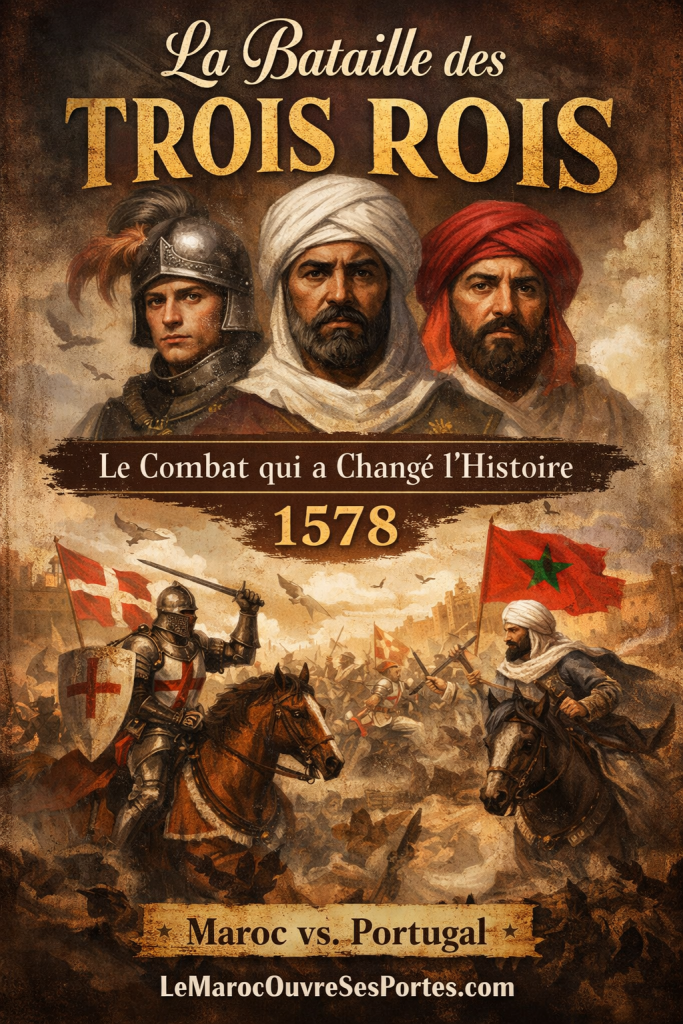
Moroccan history has been marked by many major events, but few have had as profound an impact as the famous Battle of the Three Kings, also known as the Battle of Oued al-Makhazine, the Battle of Ksar El Kébir, or the Battle of Alcácer-Quibir.
On August 4, 1578, on the plains of northern Morocco, a decisive battle pitted the Moroccan army led by the Saadian sultan Abdelmalek against the Portuguese army led by King Sebastian I. This historic confrontation would transform the political balance not only in Morocco but also in Europe.
This battle is unique in history: three kings died there on the same day, giving rise to one of the most famous episodes in Moroccan history.
But to understand the importance of this event, we must go back several years.
Morocco in the 16th Century: A Coveted Kingdom
In the 16th century, Morocco was an extremely coveted strategic territory. Located between Africa and Europe, it controlled important trade routes linking sub-Saharan Africa, the Mediterranean, and the Atlantic.
The Saadian dynasty, which ruled the kingdom at the time, had succeeded in strengthening central power and consolidating the sultan’s authority throughout Moroccan territory.
Sultan Mohammed Al-Mutawakkil, however, lost his throne after an internal power struggle. He was overthrown by his uncle Abdelmalek, who was supported by the Ottoman Empire.
Refusing to accept his defeat, Al-Mutawakkil then sought help from a foreign power: Portugal.
King Sebastian I and His Dream of Conquest
In Portugal, the young King Sebastian I harboured great military ambitions. Barely 24 years old, he dreamed of leading a crusade against the Muslims of North Africa and extending Portuguese influence in Morocco.
When the deposed Sultan Al-Mutawakkil asked for his support in reclaiming the Moroccan throne, Sebastian saw an exceptional opportunity.
He then decided to launch a major military expedition to Morocco.
In 1578, he assembled an impressive army consisting of:
- Portuguese soldiers
- European mercenaries
- noble knights
- volunteers from Spain and Italy
In total, nearly 20,000 soldiers were mobilised for this campaign.
The young Portuguese king was convinced that victory would come quickly and that he could establish lasting Christian rule over Morocco.
Sultan Abdelmalek: A Formidable Strategist
Faced with this threat, the Moroccan sultan Abdelmalek Saadi prepared to defend his kingdom.
Abdelmalek was no ordinary ruler. He had spent several years in exile in the Ottoman Empire, where he had gained extensive military and diplomatic experience.
He had a thorough understanding of modern warfare strategies and understood the importance of military discipline.
When the Portuguese troops landed in Morocco, Abdelmalek quickly assembled an army consisting of:
- Moroccan soldiers
- Amazigh cavalrymen
- allied Ottoman troops
Despite being seriously ill at the time, he personally took command of the Moroccan army.
His objective was clear: to defend Morocco’s sovereignty against the European invasion.
The Site of the Battle: Ksar El Kébir
The decisive confrontation took place near the city of Ksar El Kébir, in northern Morocco, not far from Larache.
This region was strategic because it controlled access to the kingdom’s inland plains.
The two armies faced each other on a plain crossed by the Loukkos River.
The Portuguese forces, confident in their military superiority, advanced rapidly towards the Moroccan troops.
But Abdelmalek had prepared a formidable strategic plan.
The Course of the Battle
On the morning of August 4, 1578, the two armies clashed in a violent battle.
At the start of the confrontation, the Portuguese army attempted to break through the Moroccan lines using its cavalry and heavy infantry.
But the Moroccan troops resisted with determination.
Abdelmalek used an effective strategy that involved:
- gradually surrounding the Portuguese army
- cutting off its escape routes
- using knowledge of the terrain to his advantage
As the hours passed, the situation of the Portuguese became increasingly critical.
The Moroccan soldiers gained the upper hand and began pushing the European army back towards the Loukkos River.
The battle then turned into a rout for the Portuguese.
The Death of the Three Kings
What makes this battle unique in history is the simultaneous death of three rulers.
The first was the Moroccan sultan Abdelmalek. Already seriously ill, he died during the battle, probably from a heart attack.
His death was kept secret by his officers so as not to demoralise the army.
The second king to die was Mohammed Al-Mutawakkil, the deposed sultan who had called on the Portuguese for help. He drowned in the Loukkos River while attempting to flee the battlefield.
The third was the Portuguese king Sebastian I. He disappeared in battle, and his body was never identified with certainty.
These three deaths gave the battle its famous name: the Battle of the Three Kings.
The Consequences for Portugal
The Portuguese defeat was catastrophic.
A large part of the Portuguese nobility perished on the battlefield.
The disappearance of King Sebastian plunged Portugal into a major political crisis.
With no direct heir, the Portuguese kingdom fell under Spanish rule in 1580.
This union between the two kingdoms lasted nearly 60 years.
The Battle of Ksar El Kébir therefore profoundly changed the history of Portugal and Europe.
The Consequences for Morocco
For Morocco, the victory was decisive.
It considerably strengthened the power of the Saadian dynasty.
The new sultan, Ahmed Al-Mansour, Abdelmalek’s brother, ascended the throne.
Nicknamed Al-Mansour Ad-Dahbi (the Golden), he led Morocco into a period of great prosperity.
During his reign:
- the African gold trade enriched the kingdom
- Morocco became a major diplomatic power
- Marrakech underwent spectacular development
The famous El Badi Palace was built during this period to symbolise the kingdom’s power.
A Battle That Changed History
The Battle of Ksar El Kébir is not merely a military episode.
It marks a major turning point in the history of Morocco and Europe.
It demonstrates Morocco’s ability to defend its independence against the great European powers.
It also ushered in a new period of power and prosperity for the kingdom.
More than four centuries later, this event remains one of the strongest symbols of Moroccan sovereignty.
Conclusion
The Battle of the Three Kings is one of the most significant events in Moroccan history.
This spectacular confrontation between the Moroccan army and Portuguese forces changed the destiny of several nations.
It illustrates the richness and complexity of Moroccan history, shaped by struggles, courage, and major transformations.
Even today, the memory of this battle continues to serve as a reminder of the importance of defending the kingdom’s independence and sovereignty.
© LeMarocOuvreSesPortes.com