In an oasis, a date palm is not simply the vertical shape that gives depth to a photograph. It supplies food, shade and useful material while belonging to systems of cultivation, irrigation, craft and social transmission.
In 2022, UNESCO inscribed the knowledge, skills, traditions and practices associated with the date palm on the Representative List of the Intangible Cultural Heritage of Humanity. Morocco participates in this multinational file with fourteen other states. The inscription recognises communities and practices; it does not turn every palm grove into a certified attraction.
A tree connected to arid environments
UNESCO describes the date palm as an evergreen plant whose roots can reach deeply for moisture. It grows in oases where available water supports irrigation. Its presence therefore depends on a precise relationship between soil, water, human care and climate.
Describing an oasis as purely “natural” without acknowledging that work removes an essential part of the landscape. Channels, water turns, plots and layered crops reflect knowledge accumulated and adjusted to each territory.
Much more than a date harvest
The practices in the UNESCO record include planting, care, irrigation, pruning, pollination and harvesting. They require gestures, timing and an ability to read the tree that cannot be improvised for a tourist demonstration.
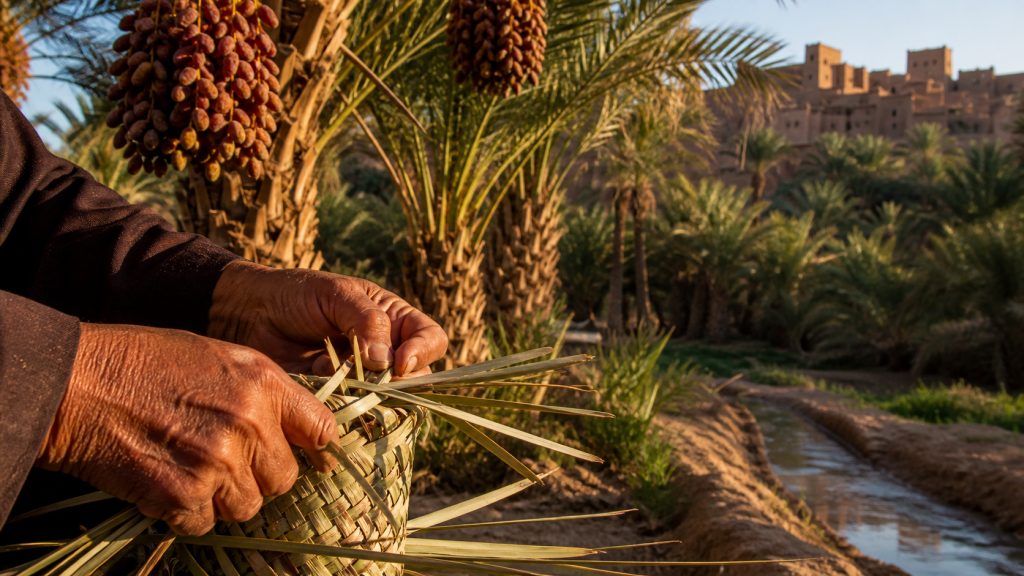
Dates are a food and commercial resource, but the whole plant carries value. Leaves, fronds and fibres can become useful objects. Wood and dried parts have also served local needs, within forms of management that must protect the palm grove.
Fibres shaped through craft
Basketry turns palm material into baskets, containers, mats and practical objects. The visible result reveals only part of the work. Selecting, preparing, drying and softening the material before building an even weave are all separate skills.
When buying an object, ask who made it, where the material came from and whether the price genuinely pays for the work. An “artisan” label without provenance cannot guarantee that knowledge is transmitted or that the community benefits.
A place in language and social practice
UNESCO’s file also links the date palm to poetry, songs, gatherings and social practices. The tree is therefore a symbolic reference as well as an agricultural resource.
Meanings vary between countries, regions and families. It would be misleading to present a custom observed in one oasis as a universal Moroccan rule. A local guide or craftsperson can explain context more accurately than a general commentary learned elsewhere.
How knowledge is transmitted
Transmission takes place through observation, practice, stories and learning alongside experienced people. The file also notes more structured forms of education. Combining them can help younger generations understand established gestures while responding to environmental and economic change.
UNESCO inscription draws attention to that process. It does not freeze a practice in the past. A contemporary basket, an adapted technique or a new outlet can support continuity when the holders of knowledge remain involved in decisions.
Visit an oasis respectfully
A palm grove may be a workplace, private property and a fragile ecosystem at the same time. Stay on authorised paths, do not cross irrigation channels, do not pick fruit and ask before photographing a person or plot.
If a guided visit is offered, check who leads it, the group size, the real content and how local participants are paid. Reject promises of an “authentic” encounter imposed on residents or a demonstration arranged without consent.
Connect heritage with destinations
Palm groves shape several southern Moroccan territories and valleys. Zagora, Tinghir, the Drâa, Tafilalet and parts of the Taroudant area reveal different relationships between water, cultivation and settlement.
Use the MOP Destinations catalogue to choose a coherent base. Do not collect oases as interchangeable scenery. Take time to identify the territory, its constraints and the people maintaining the landscape.
What to remember
The date palm brings together agriculture, craft, food and cultural expression. Its 2022 inscription recognises heritage shared across several countries, including Morocco, and emphasises the communities that transmit it.
For a traveller, the most respectful response is straightforward: look beyond the silhouette, pay transparently for knowledge and move through palm groves as living places.
Sources consulted
- UNESCO, “Date palm, knowledge, skills, traditions and practices”, file 01902, inscribed in 2022: https://ich.unesco.org/en/RL/date-palm-knowledge-skills-traditions-and-practices-01902
- UNESCO, decision 17.COM 7.b.33, adopted in Rabat in 2022: https://ich.unesco.org/en/decisions/17.COM/7.B.33