
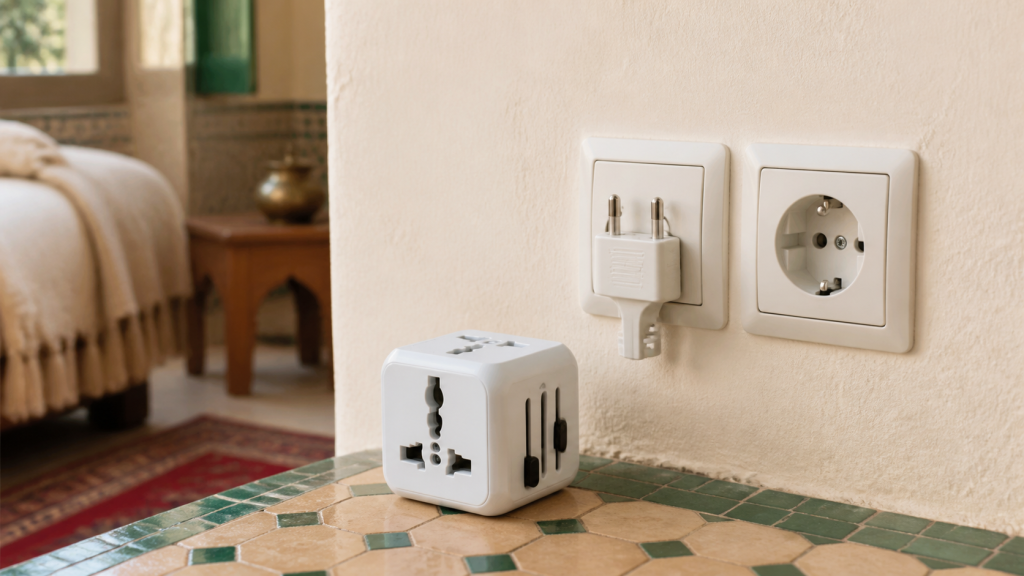
For a phone or laptop charger labelled “Input 100–240 V, 50/60 Hz”, start with a practical question: does its plug fit the socket in front of you? If it does, you do not need a plug-shape adapter. If it does not, you need a compatible one. Either way, read the device label before connecting it: a plug adapter does not convert voltage.
Institutional visitor guides consulted for Morocco describe a supply of about 220 V at 50 Hz and Type C and E plugs or sockets. These are useful travel-planning references, not a promise about every outlet in an accommodation. Morocco’s National Office of Electricity and Drinking Water (ONEE) also describes 220 V among domestic low-voltage uses. Sources were checked on 28 September 2026; the ITU and UNFCCC visitor notes cited below relate to 2024 and 2017 respectively.
Three checks before you plug in
- Plug shape: compare your plug with the actual socket. The cited guides describe Types C and E; never force a plug that does not fit securely.
- Input rating: read “Input” on the charger or appliance. A range of “100–240 V, 50/60 Hz” covers the values stated in those guides. A device marked only “110–120 V” does not.
- Earthing and power: if the appliance needs an earth connection or draws substantial power, check the adapter and socket specifications alongside the manufacturer’s instructions. Matching pins alone do not prove the arrangement is suitable.
A two-round-pin plug may work for a small, correctly rated charger. For an earthed plug, do not assume a compact adapter preserves that protection: check explicitly. Electrical installations may differ between accommodations.
Plug adapter or voltage converter?
A plug adapter only changes the physical connection. It does not change the supply voltage or frequency. If your device accepts only 110–120 V, do not connect it directly to a supply described as 220 V. Ask the manufacturer or consult its instructions before choosing any solution; for some appliances, leaving them at home is simpler.
This matters especially for heating appliances, older equipment and high-wattage devices. A universal adapter is not, by itself, proof of suitability. Check its power rating and whether an earth connection is needed. Electrical Safety First explains these limits; IEC 60884-2-5:2017 sets out the scope of a travel-adapter standard but does not certify a particular product.
Chargers and medical devices
For a phone, tablet or laptop, inspect the rating on the power supply you will actually use, not only the device. Use an undamaged cable and plug. If an outlet is loose, damaged or hot, stop using it and tell your accommodation.
For a medical device, ask its manufacturer or your care supplier before departure about the exact voltage, frequency, earthing and backup-power requirements. Confirm the location of the necessary socket with your accommodation. A photo of an outlet, or the presence of an adapter, does not establish compatibility or continuity of power.
A short packing check
- Photograph the “Input” label on important devices and read the manufacturer’s instructions.
- Bring a plug adapter only when the shape requires one, and check that its specifications suit the device.
- Do not rely on an adapter to power a 110–120 V-only appliance.
- Obtain device-specific advice for earthed, high-power or medical equipment.
- Replace damaged cables and avoid unstable outlets.
Continue with Plan your trip with MOP, the guide to SIM cards and internet in Morocco and entry requirements.
Sources consulted
- ONEE, “low voltage” glossary, publication date N/A, accessed 28 September 2026: 220 V among domestic uses.
- International Telecommunication Union, Marrakech participant guide, 2024 event, accessed 28 September 2026: 220 V, 50 Hz and Type C.
- UNFCCC, practical information sheet for Morocco, 2017, accessed 28 September 2026: Types C and E, 220 V and 50 Hz.
- Electrical Safety First, travel-adapter guidance, last update N/A, accessed 28 September 2026: adapter limits, earthing and power rating.
- International Electrotechnical Commission, IEC 60884-2-5:2017, published 11 May 2017, accessed 28 September 2026: scope of the travel-adapter standard.