Falconry is on UNESCO’s Representative List of the Intangible Cultural Heritage of Humanity through a multinational nomination that includes Morocco. UNESCO describes it as the traditional art and practice of training and flying falcons, and sometimes other birds of prey, through a relationship built with the bird and its environment.
Recognition does not turn every bird-of-prey display into a heritage practice. It asks observers to consider transmission, care, knowledge, communities and conservation—the elements that give falconry meaning.
An old practice with a social heritage
Falconry was historically connected with hunting and obtaining food. UNESCO notes that it gradually acquired social, recreational and cultural dimensions as well as a relationship with nature.
“Heritage” does not freeze the practice in the past. It refers to knowledge and gestures that people still pass on. Methods can evolve with regulation, veterinary knowledge and conservation goals without losing all cultural continuity.
The bond with the bird is central
A bird of prey is neither a costume accessory nor a photographic object. Training requires time, attentive observation, suitable food, controlled equipment and the ability to recognise stress or fatigue.
UNESCO places the bond between falconer and bird among the values shared across participating countries. That relationship explains why a dramatic image of flight is not enough to understand the practice.
Transmission relies on guidance
The nomination describes learning within families, through mentoring and in clubs or training structures. In Morocco as elsewhere, learning does not consist only of repeating a gesture in front of an audience.
It involves bird behaviour, preparation of equipment, reading the terrain and taking daily responsibility. Transmission also includes vocabulary, stories, forms of sociability and ways of respecting habitats.
A genuinely multinational inscription
Falconry appears in a nomination shared by countries in Europe, Asia, Africa and the Arab world. Morocco does not claim exclusive ownership. Communities give the practice local forms within a set of shared techniques and values.
That dimension prevents two simplifications. Falconry is not identical folklore everywhere, and it is not an isolated Moroccan curiosity. Comparison should recognise differences without erasing historical links among communities.
Conservation and heritage need to remain connected
The modern practice described by UNESCO emphasises preservation of falcons, quarry and habitats. A responsible presentation cannot ignore the bird’s origin and condition, the applicable permissions or the way it is kept.
MOP does not provide legal advice on possession or transport of a bird of prey. Rules can depend on species, country and circumstances. Anyone faced with a doubtful offer should contact the competent authorities rather than rely on a tourism promise.
What a visitor can observe
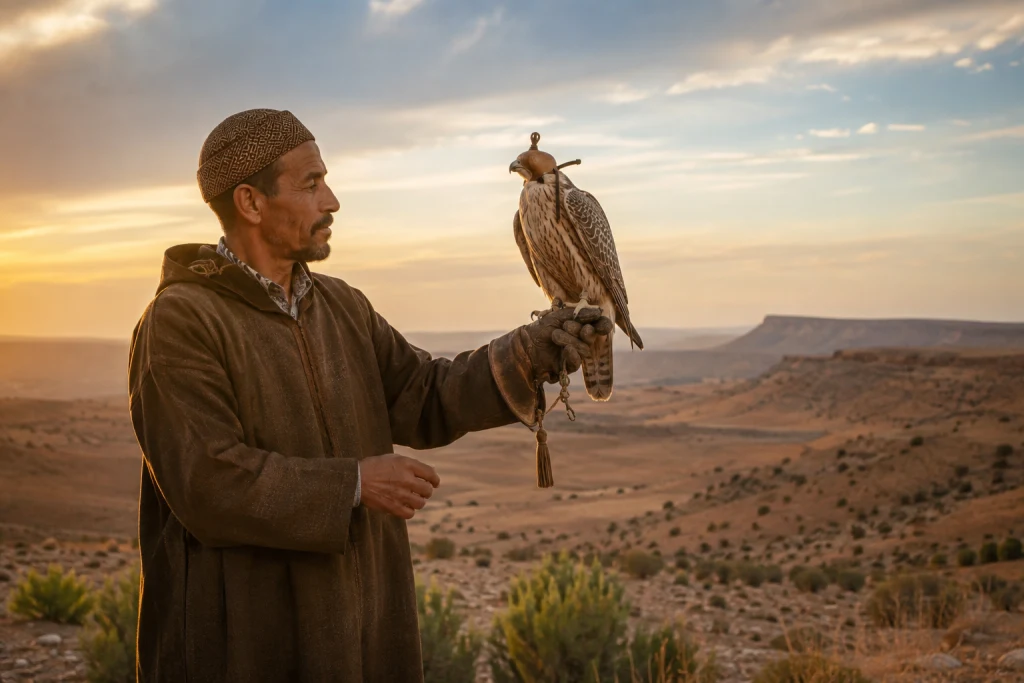
At a properly managed demonstration, visitors can notice the bird’s posture, glove, leash, hood, signals and the way the falconer maintains distance from the public. An explanation of welfare and conservation matters more than an invitation to multiply posed pictures.
A bird that appears calm is not permission to touch it. Follow the professional’s instruction. If the setup passes the animal from hand to hand or dismisses visible stress, walking away is a reasonable decision.
Photograph without disturbance
Sudden movement, flash and a crowd moving closer can disturb a raptor. Ask before photographing, respect the stated distance and avoid standing on a flight path.
Photography must respect people too. A falconer may allow a picture of the bird while not wishing to appear. Commercial publication requires a different permission from a private souvenir.
Do not confuse an encounter with a heritage guarantee
UNESCO inscription concerns a practice and the communities transmitting it. It does not create a commercial label for every provider. An advert using the UNESCO name proves neither quality of care nor authenticity.
Concrete questions are more useful: who cares for the birds, how is rest organised, what is the educational purpose, which rules govern the encounter, and what happens if weather or the animal’s condition prevents flight?
What the practice can inspire
Falconry suggests a different relationship with travel time. Its substance lies in patience, attention and trust rather than an accumulation of images. Understanding a slow gesture can be more memorable than obtaining a close-up photograph.
This reading matches the MOP approach: context before choice. No affiliate offer appears in this article because MOP does not currently have an activity whose welfare, legal and transmission conditions have been verified sufficiently.
Checklist for responsible observation
- Verify who organises the encounter and under which framework.
- Ask how bird welfare and rest are protected.
- Never touch, feed or move a raptor without instruction.
- Avoid flash and keep the requested distance.
- Do not present UNESCO inscription as an individual commercial label.
- Leave if the bird’s condition or the setup seems incompatible with responsible practice.