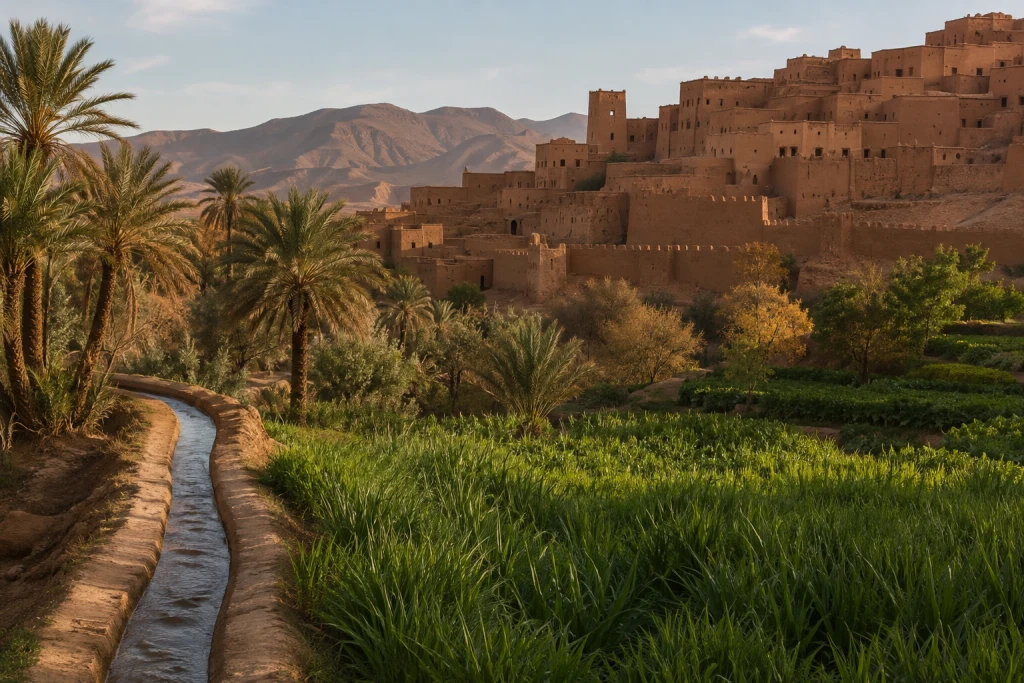
Figuig lies in Morocco’s Oriental region at the edge of the desert. Its value is not contained in one monument. The oasis combines seven ksour, earthen architecture, tiered gardens, a palm grove and an irrigation system. The file submitted by Morocco to UNESCO describes these elements as one coherent material, social and cultural ensemble.
Figuig has appeared on the World Heritage Tentative List since 2011. That means Morocco may consider a future nomination; it is not an inscription on the World Heritage List. The distinction matters when planning a visit or reading any offer that uses the word UNESCO.
Seven ksour, not one backdrop
The official file describes seven ksour and their earlier sites as a homogeneous ensemble despite their spatial separation. A traveller should not look for one gate that represents the entire oasis. Each sector has routes, homes and uses that a tourism map will inevitably simplify.
Choose a guided visit or a small number of understood points. An open passage does not make a house, roof or garden public. Ask before crossing a threshold and accept that some spaces are not available to visitors.
Earthen architecture needs distance
Walls, towers, mosques and homes use local materials, including dried earth and palm wood. These structures are maintained and rebuilt. They are neither abandoned ruins for exploration nor ownerless façades.
Do not climb a wall for a view or rest equipment against a vulnerable surface. Rain and repairs can change a route. A local guide can help distinguish visible heritage, active places and private property.
Tiered gardens organise the oasis
The palm grove is more than a row of date palms. UNESCO documentation describes tiered gardens in which several crops grow beneath palm shade. The arrangement creates a microclimate and records a patient adaptation to a demanding environment.
Stay on indicated paths, pick nothing and do not block farm access. The best hour for photography may not be the best hour for work. A responsible visit adjusts to residents instead of asking them to become figures in the landscape.
Water is social infrastructure
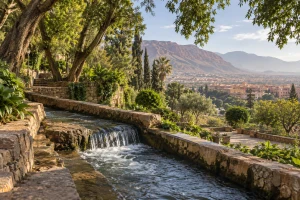
Foggaras, basins, water dividers and channels form the irrigation system cited in the Tentative List file. Water is therefore not a picturesque extra. Its distribution depends on knowledge, rules and collective maintenance.
Do not walk in a channel or move a stone to improve a photograph. Ask how the system works rather than inventing an explanation. In an oasis, wasting water or demanding excessive comfort directly contradicts the lesson of the landscape.
Preparing for a remote destination
Morocco’s national tourism office places Figuig at the end of a long route through the Oriental region. Road times, timetables and services need confirmation for the actual date. An older institutional brochure provides geographical context, not an operational guarantee.
Build the outward and return journeys before adding visits: confirmed transport, daylight arrival, first night and a local contact. Save essential information offline. If a connection is uncertain, add margin instead of adding another stop.
Choosing guidance that provides context
Useful guidance explains the relationship between ksour, gardens and water. It states the meeting point, length, language, accessible areas and total price. It does not promise entry into a home, religious building or plot without permission.
Before paying, verify the operator’s identity and cancellation terms. MOP displays no price or availability without an active partner offer. An editorial recommendation cannot turn an unverified service into a secure booking.
Photographing without extracting the place
Prefer wide views and authorised details. A recognisable person, interior or agricultural task requires a clear request. Showing the image afterwards helps confirm what may be kept or published.
Avoid precisely geotagging fragile infrastructure or private access. Photography should help explain the whole, not create a shortcut to a sensitive point. Residents retain the right to refuse without having to justify the decision.
Staying and buying coherently
Nearby accommodation can support a slower visit when its address, access, water, food and cancellation terms are clear. Ask how the property fits into the oasis rather than relying on a word such as authentic. A recent building is not responsible merely because its walls are earth-coloured.
For dates or crafts, ask about origin, material and price before buying. Do not describe every item as old or every product as cooperative-made without evidence. Transparency is more valuable than an attractive story that cannot be documented.
Building a realistic day
One day can include a contextual walk through an accessible sector, time in the gardens and an arranged meeting. It also needs breaks, water and a return margin. The goal is not to collect all seven ksour in haste.
Figuig rewards progressive understanding. Architecture, farming and irrigation form one living system. The more a plan respects that coherence, the less the oasis becomes an image backdrop and the more the journey understands what it sees.