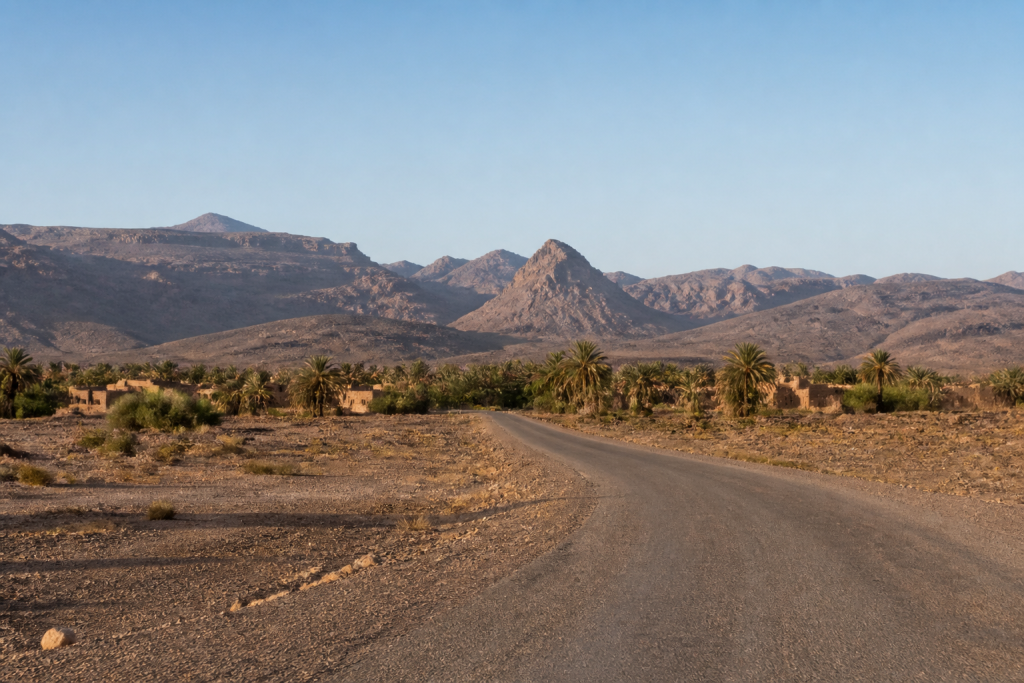
Foum Zguid, in Tata province, occupies a transition zone between oases, the Bani ranges and pre-Saharan spaces. Morocco’s official portal presented it in August 2026 as an emerging destination and a starting point for desert circuits. That visibility does not turn every track into an ordinary tourist road.
A responsible stop begins by separating three decisions: reaching the town on paved roads, staying in the inhabited area and travelling beyond the main roads with a capable operator. Each requires a different level of preparation.
Place Foum Zguid in a realistic itinerary
Foum Zguid lies in southern Morocco, east of Tata and south of the Tazenakht corridor. Its role as a crossroads makes it relevant for travellers linking valleys, oases and desert landscapes. It is not a quick extension of Marrakech to squeeze between two visits.
Calculate the route with an up-to-date planning tool, then add time for breaks, heat and road conditions. Avoid combining Foum Zguid, Tata, Zagora and an off-road circuit on the same day. A map can seriously underestimate fatigue.
Understand the town before the track
Maroc.ma reported that the local offer included nine classified tourism establishments and more than 430 beds when its story was published on 18 August 2026. Those figures describe declared capacity at that date, not guaranteed availability for a particular night.
Choose a genuine base first, confirm its address and ask how late arrival is handled. Accommodation staff may offer useful local context about roads, but a commercial recommendation is not a substitute for checking a guide’s identity and competence.
Do not confuse a road with a desert track
A vehicle suited to asphalt is not automatically suited to sand, rock or an isolated crossing. Away from the road, the itinerary may depend on weather, visibility, the vehicle and the driver’s experience.
Do not simply follow a downloaded trace. Check access conditions, fuel, communication, water, the spare wheel and the return plan. For a first excursion, documented local guidance is more prudent than improvised navigation.
Ask an operator precise questions
Request the legal name of the company or guide, the vehicle used, the passenger limit, meals and accommodation included, departure point, expected return and breakdown procedure. Ask which activities are cancelled when conditions become unsafe.
A price alone cannot compare two trips. One may be a short transfer while another covers several days. MOP publishes no dynamic fare or availability without a current transactional source.
Plan for water, heat and limited coverage
In an arid environment, the safety margin matters more than the ideal programme. Carry an appropriate reserve of water, sun protection, covering layers, personal medication and a supply independent of anything promised by an excursion.
Download essential information offline, but do not treat a saved map as an emergency system. Give a contact the planned route and return time. If mobile coverage disappears, your arrangements should already account for that limit.
Respect inhabited places and oases
Palm groves, wells, fields and earthen buildings are not empty scenery. Use authorised access, do not cross a fence or channel and ask before photographing a person, a home or agricultural work.
Buying locally may support the area, but avoid vague promises of “authenticity”. Look for clear provenance, transparent pricing and a consensual exchange. Discretion matters as much as spending.
Know when to change the programme
A weather warning, damaged road, extreme heat, unsuitable vehicle or unavailable guide is enough reason to remain on a confirmed route. The desert does not reward persistence for its own sake.
Plan an alternative in town or along a verified road. The value of the stay does not depend on reaching the most remote track.
Build a MOP stop
- Stay one night before a long excursion so conditions can be confirmed.
- Set one principal objective for each day.
- Use an identifiable provider and a vehicle matched to the terrain.
- Check water, fuel, communication and the return independently.
- Reuse no price, timetable or promise from an old screenshot.
- Keep a safe alternative for changing conditions.
The MOP Destinations catalogue helps place Foum Zguid in a wider journey. Treat the town as a living territory and the track as a prepared activity—never as a shortcut between photographs.