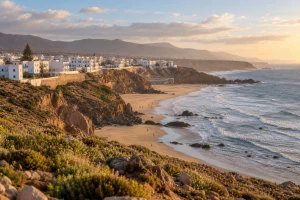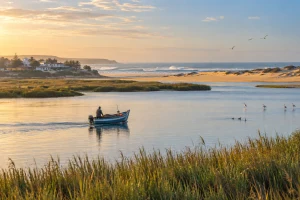
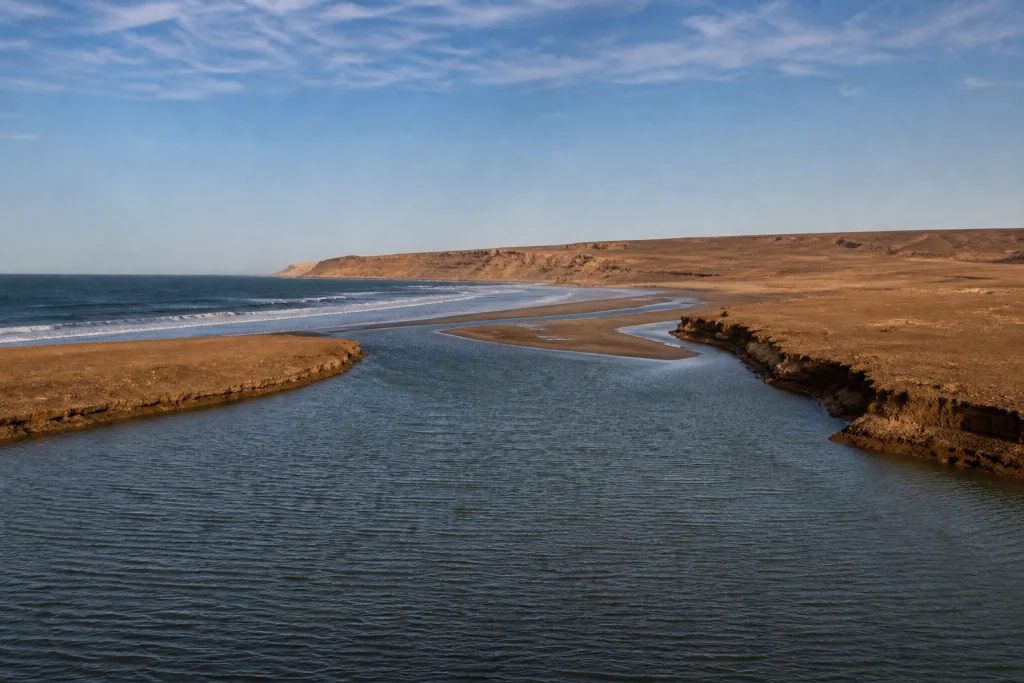
Khnifiss Lagoon lies north-east of Tarfaya, in a landscape where Atlantic water meets a desert environment. Morocco’s submission to the World Heritage Tentative List describes a set of habitats and also mentions archaeological remains. The site is recognised as a wetland of international importance in Ramsar documentation.
Those statuses do not make it an improvised excursion. Isolation, wind, tides, heat and fragile habitats require more preparation than a brief photo stop. A sound programme begins with the road and return, then leaves enough time to observe without chasing birds or multiplying movements.
Understand a lagoon connected to the ocean
A lagoon is a place of exchange between land, water and ocean. At Khnifiss, the shape of the shore, tides, mudflats and water areas create several habitats. The landscape may therefore change visibly with time and conditions.
That variation is part of the experience. Do not promise one colour, water level or animal presence throughout the year. A relevant visit accepts what can be observed at that moment and never turns wildlife into a guaranteed result.
Locate the stop before drawing the route
Tarfaya is the most useful reference, but the lagoon is not an urban district. Confirm the exact access point, road distance, fuel, network and return solution. One name on a map can cover several sectors, tracks or viewpoints.
Do not build a day that combines Khnifiss, long coastal legs and a late arrival. Fatigue and night driving increase risk without improving observation. A short, legible stop is better than a poorly controlled spectacular detour.
Read the designations accurately
Khnifiss has appeared on Morocco’s UNESCO Tentative List since 1998. A tentative list records properties a state may consider nominating; it is not the same as inscription on the World Heritage List. MOP must keep that distinction visible.
The Ramsar record provides another framework, focused on wetlands. Both references underline the place’s importance, but neither alone supplies today’s opening, access or activity conditions. Operational information must be confirmed separately.
Observe without disturbing
Keep a distance from birds, resting areas and nests. Avoid shouting, amplified music, drones and repeated approaches for a photograph. Binoculars or a telephoto lens support more respectful observation than moving towards an animal.
Collect no plant, shell, rock or archaeological fragment. Take all waste away, including organic waste, and use existing access. In an arid environment, a vehicle mark or discarded item may remain visible for a long time.
Choose useful local guidance
A local guide can help identify the sector, understand tides, read habitats and avoid sensitive areas. Confirm identity, meeting point, language, vehicle, duration and what is genuinely included.
If a boat trip is offered and authorised, it should state equipment, capacity, sea conditions, lifejacket and cancellation. MOP displays neither price nor availability without active, recent partner data. No offer is better than an unverifiable recommendation.
Prepare for water, wind and autonomy
Carry more water than for an urban visit, plus sun protection, a wind layer, a simple first-aid kit and offline navigation. Tell someone your route when the stop is isolated.
Consult both general and marine weather vigilance before leaving. Wind and ocean conditions can change an outing even under a clear sky. If access or return remain uncertain, use a simpler viewpoint or postpone the stop.
Photograph a landscape, not proof of arrival
The lagoon rewards wide views and patient observation. Seeking the exact angle from a viral image often encourages visitors to leave reasonable access. The goal is not to prove that you reached the most isolated point.
Photograph without publishing the precise location of a sensitive area, and do not centre a local person without consent. The strength of the story comes from understanding the environment, not manufacturing rarity in the frame.
Build a restrained stop
A responsible visit can follow three stages: arrive in daylight, observe with guidance or from established access, then return with a margin. Add an overnight stay only when accommodation, address, water, electricity and cancellation terms can be verified.
Do not describe Khnifiss as a conventional beach or an attraction available at every hour. It is a sensitive desert wetland shaped by uses the visitor must respect. Restraint makes the stop stronger and more honest.