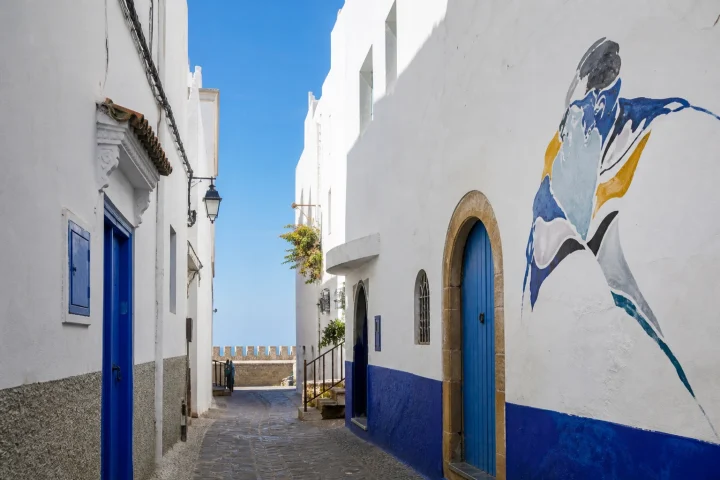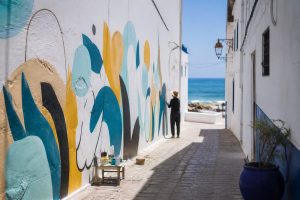
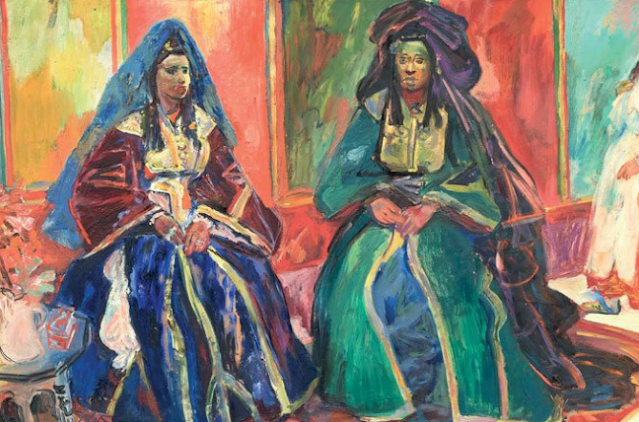
Moroccan contemporary art is experiencing a real boom, driven by artists who reinterpret Moroccan traditions and bring them into dialogue with modern and global perspectives. These innovative creators explore themes as varied as identity, memory, culture and social issues, and their work is helping to place Morocco on the international art scene. In this article, we invite you to discover some influential artists who are shaping the landscape of Moroccan contemporary art and offering a unique perspective on the country’s cultural evolution.
Hassan Hajjaj: Pop Art Made in Morocco
Hassan Hajjaj, often nicknamed the “Moroccan Andy Warhol”, combines photography and pop art to reinterpret iconic images of Moroccan culture. His colourful, unconventional style uses patterns inspired by Moroccan popular culture: polka-dot fabrics, tea tins and frames made from local consumer products. Hajjaj captures vibrant and unique portraits, particularly of Moroccan women, while incorporating a reflection on identity and the influence of globalisation. His work, exhibited around the world, redefines the conventions of photography and modern Moroccan art.
Mounir Fatmi: Exploring the Limits of Knowledge and Memory
A renowned conceptual artist, Mounir Fatmi uses installations, videos and sculptures to explore themes such as knowledge, religion and social taboos. His work often questions the relationship between tradition and modernity and seeks to encourage reflection on the place of memory and identity in a constantly changing world. Fatmi has exhibited at renowned institutions such as the Centre Pompidou in Paris and the Guggenheim Museum in New York, confirming the importance of his work on the international scene.
Younès Rahmoun: Between Spirituality and Minimalism
Originally from Tetouan, Younès Rahmoun is interested in the links between art, spirituality and nature. Through a minimalist style, he creates refined and poetic installations that symbolise his quest for inner harmony. His work, influenced by Sufi meditation and spiritual values, reflects a deep respect for nature and a search for peace. Rahmoun is a perfect example of a Moroccan artist who draws on his roots to create works with universal resonance.
Lalla Essaydi: Reinventing the Representation of Women
Photographer Lalla Essaydi explores representations of Moroccan and Arab women, particularly in intimate and traditional spaces. Her photographs, often created in richly decorated interiors, address the complexity of female identities in Arab culture. Essaydi adds delicate calligraphy to her photographs, using henna to write words on her subjects’ bodies. Her work is a critical reflection on gender stereotypes and social norms that transcends Morocco to address universal issues.
Mohamed Melehi: The Pioneer of Moroccan Modern Art
Although he died in 2020, Mohamed Melehi remains one of the pillars of contemporary art in Morocco. This artist and teacher was a pioneer of the Moroccan art movement in the 1960s and influenced many young creators. His work, recognisable by its geometric forms and bright colours, draws inspiration from traditional Moroccan patterns while incorporating elements of modernity. Melehi is particularly known for his murals and works that symbolise the spirit of freedom and artistic renewal in Morocco.
Nour-Eddine Jarram: A Critique of Contemporary Society
Nour-Eddine Jarram, a Moroccan artist living in the Netherlands, uses painting and drawing to offer a satirical view of modern society, its excesses and its contradictions. His works feature characters drawn from the popular imagination, whom he places in unrealistic situations to prompt critical reflection. Jarram draws inspiration from his Moroccan roots while incorporating references to Western culture, thereby creating an intercultural and introspective dialogue.
The Moroccan Art Scene: Towards International Recognition
These Moroccan artists and many others are helping to position Morocco as a major player in contemporary art in Africa and around the world. Thanks to art biennials, international exhibitions and galleries that are increasingly present in major capitals, Moroccan contemporary art now shines far beyond the country’s borders.
The diversity of styles and subjects addressed by contemporary Moroccan artists reflects a country undergoing profound change, proud of its past while remaining open to the world. Whether through photography, painting or conceptual installations, Moroccan contemporary art is redefining national culture and showing the world the richness of a multifaceted and vibrant identity.
Contemporary Art, a New Cultural Language in Morocco
Moroccan contemporary art is much more than a simple form of artistic expression: it is a mirror of society, a catalyst for debate and a driving force for cultural evolution. Moroccan artists boldly reinterpret traditions and explore universal themes, creating a unique artistic language that resonates both in Morocco and internationally. Their works are invitations to explore, question and understand Morocco in all its richness and complexity