
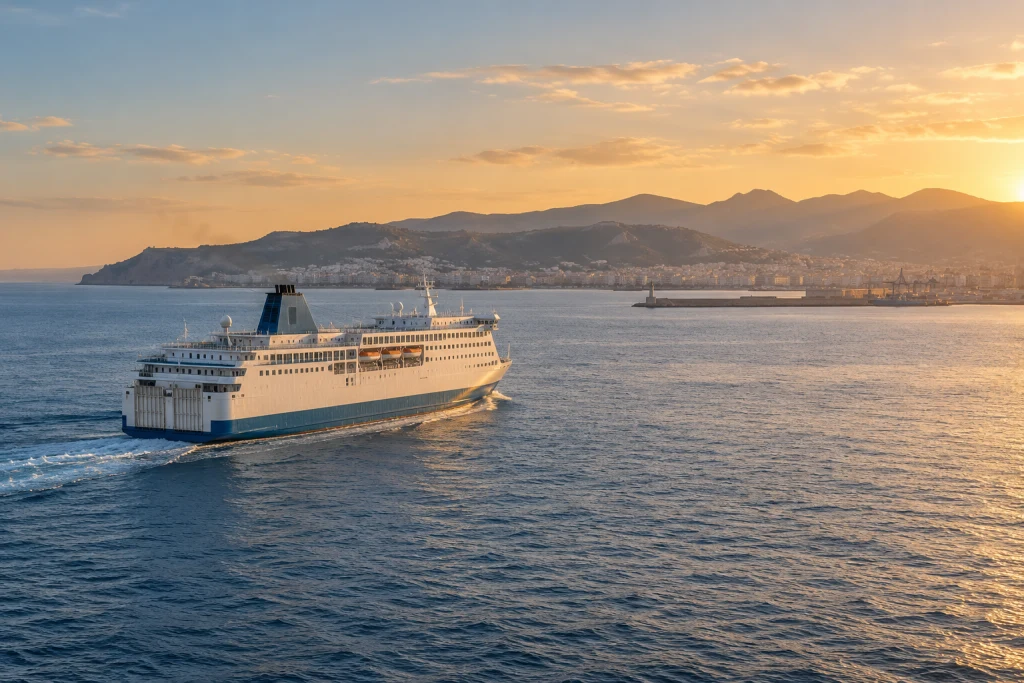
MOP editorial illustration — generated image, not a depiction of any specific event.
An agreement announced, not a new crossing
Morocco’s National Tourism Office, ONMT, and ferry operator GNV have announced a three-year partnership covering 2027 to 2029. Both parties describe cooperation intended to promote Morocco and develop maritime passenger travel between the country and Europe, especially from Italy. This is a strategic and promotional announcement. Neither of the statements consulted confirms that a new ferry route has opened immediately or gives a timetable for one.
That distinction matters to someone already planning a trip. The agreement may affect how Morocco appears in sales channels and how a crossing and a stay are presented together. It does not replace a route description, a departure schedule or a booking confirmation. MOP therefore keeps the verified fact — a partnership has been announced — separate from any promise of a service that has not yet been published.
The timetable and stated commitments
GNV’s statement dated 5 October 2026 places the partnership in the 2027–2029 period. ONMT’s statement, carried by the official Maroc.ma portal on 6 October, likewise describes a joint action plan for the next three years. The documents agree on the duration and general direction, even though their accounts of where the agreement was signed are not identical. That location is not needed to understand what has been announced.
The stated commitments include joint communication campaigns, destination promotion and travel proposals combining a sea crossing with Morocco’s tourism offer. ONMT explicitly mentions a campaign in the Italian market. GNV also refers to its own channels and several European markets. These are plans to be implemented, not a catalogue already showing fixed prices, dates and conditions throughout the partnership’s entire duration.
Why the Italian market is central
ONMT says 1.15 million Italian tourists visited Morocco in 2025 and that 15% arrived by sea. These figures are retrospective data attributed to the tourism office; they do not measure the effect of the agreement announced in October 2026. They do explain why the partners are focusing on a journey that connects maritime transport, arrival at a port and the experience of visiting the country.
The office sets a target of 350,000 passengers departing Italy. That number must be read as an ambition of the partnership, not traffic already achieved or guaranteed. The public statement does not yet provide a detailed timetable showing when the target would be measured. Assessing the result will require a comparison baseline, a defined period and traffic figures published after the programme is put into practice.
What GNV’s figures and ships tell us
GNV places the announcement alongside its existing business. The company reports approximately 2.2 million passengers across its whole network between January and September 2026, up 2% from the equivalent period in 2025. It also reports 1.84 million linear metres of freight, an increase of 5%. Those figures describe the operator’s network as a whole, not only crossings to Morocco.
In an earlier statement dated June 2026, GNV said its Moroccan routes carried more than 465,000 passengers in 2025 and described the assignment of Aurora and Virgo to those services during summer 2026. These details show that maritime activity serving Morocco predates the ONMT agreement. They do not establish the capacity, frequency or fares that will be offered in 2027.
What this means when planning a journey
For travellers, the immediate value is knowing where information should be checked. A joint campaign may make Morocco more visible as a destination reachable by sea, but the choice of crossing must still be based on routes the operator actually displays for the intended dates. Departure port, arrival port, journey duration, vehicle rules and cancellation terms remain separate checks before a booking decision can be made.
A travel idea must also be distinguished from a bookable product. If a proposal combining ferry and tourism appears later, it will need to say what is included, who sells each element and which conditions apply. Once in Morocco, the onward journey from the port matters as much as the crossing. MOP keeps that practical view without inferring commercial availability from an institutional agreement that does not demonstrate it.
What still needs confirmation
The next useful evidence will be actions actually launched, any offers published by GNV, schedules for the relevant season and comparable passenger counts over time. The statements consulted give no price, announce no newly opened route and set no precise timetable for additional sailings. They also do not say whether a traveller will be able to buy every element of a jointly promoted stay in one transaction.
The partnership is therefore a signal of tourism cooperation between Morocco and Italy, not yet a verifiable change to an individual journey. Before booking, readers should consult the operator’s dated information and the conditions for their exact route. MOP will update this account only when the partners publish observable measures, keeping their goals, documented results and concrete choices available to travellers distinct.
MOP guide to arriving through Tanger Med