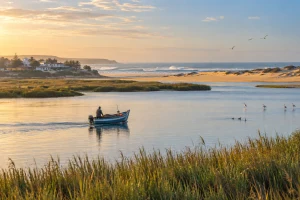
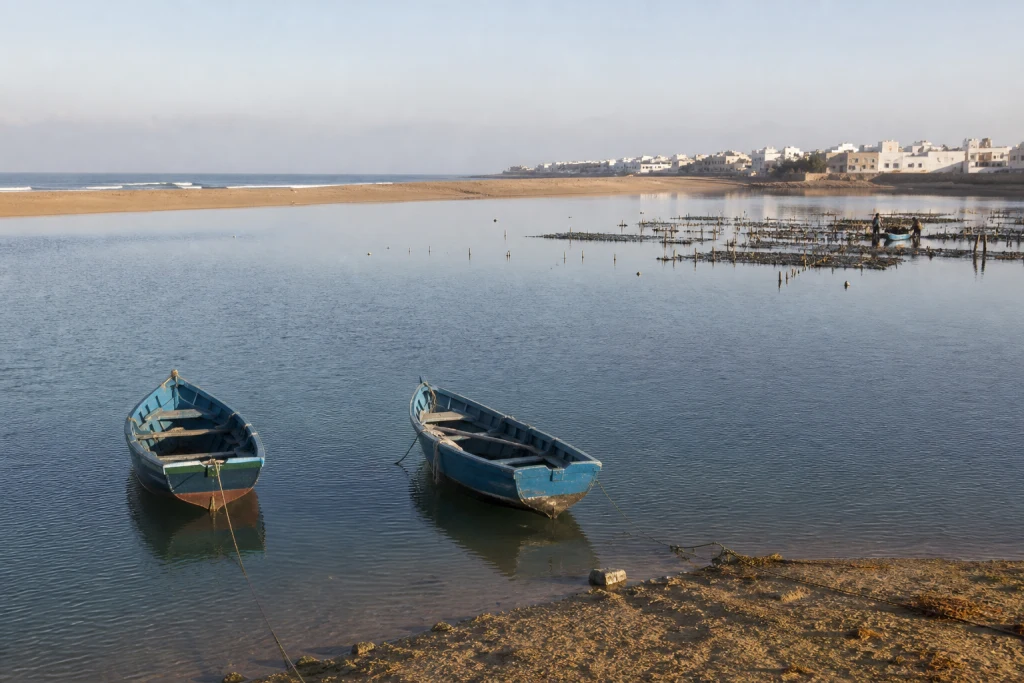
Between El Jadida and Safi, Oualidia is organised around a lagoon separated from the Atlantic by sand and openings to the sea. Morocco’s national tourism office associates the destination with calm water, beaches, oysters and a local economy connected to the coast.
That peaceful image should not hide the fact that the lagoon belongs to a wider wetland system. MOP therefore recommends a slow stop: observe the site, choose only a few activities and check present conditions instead of promising the same day in every season.
Understand the shape of the place
The lagoon is neither a uniform natural swimming pool nor a completely enclosed bay. Ocean exchange, tide, wind and sandbanks change the landscape. A spot that appears calm at one hour may have a different current or depth later.
Begin with a walk on authorised access and see how village, beach, channels, oyster beds and ocean fit together. This first reading reduces the risk of crossing a working area or walking onto a bank that the tide may isolate.
Place Oualidia within a wetland complex
The Sidi Moussa-Walidia Complex is listed by the Ramsar Sites Information Service. The recognised ecological area is larger than the beach most visitors use.
Recognition does not mean a particular trail, hide or excursion is always open. Its practical message is to respect habitats by limiting noise, waste, collection and disturbance to birds.
Choose a two-day rhythm
A first day can combine orientation on foot, time by the water and a meal based on local produce. A second may include a guided water activity or naturalist outing after checking weather, tide, equipment, authorised zone and operator competence.
This pace leaves room for wind or unsuitable conditions. It also avoids trying to add El Jadida, Safi, a boat trip and several distant beaches to the same day.
Approach oyster farming with context
Official tourism documents present Oualidia as a destination known for oysters. Eating them locally may support the economy, but reputation does not replace information from the seller or individual food precautions.
Ask where the product came from, how it was stored and what it costs before ordering. Anyone with an allergy, pregnancy, particular vulnerability or concern about raw shellfish should follow appropriate medical advice rather than a general travel tip.
Prepare for an activity on the water
Before booking, identify the organiser, departure point, duration, equipment, weather policy and conditions for children or beginners. A suitable buoyancy aid and a safety briefing are not optional details.
Do not confuse visually calm water with an absence of risk. Leave if supervision seems improvised, equipment is damaged or participants are asked to enter an area marked as closed.
Watch birds without pursuing them
Binoculars help maintain a useful distance. Stay on paths, keep voices low, never feed wildlife and do not provoke a bird into flight for a photograph.
Species and seasons vary. MOP therefore does not promise a particular sighting. A competent local guide should explain site rules as clearly as the birds visible on that day.
Verify access and accommodation
Oualidia is reached by road. Before leaving, confirm the route, the exact stop for any shared transport and the solution for the final kilometre. An old frequency found online is not a current timetable.
For accommodation, compare the real address, pedestrian access, possible parking, noise, arrival hours and cancellation terms. “Lagoon view” can describe very different situations, so request a precise description rather than relying on a general promise.
Protect a fragile stop
Take waste away, refuse unnecessary plastic and do not buy collected shells or souvenirs made from protected species. Use existing access and never cross oyster-working installations.
A responsible visit does not demand a private viewpoint at any cost. It accepts that an area may be reserved for work, breeding or safety, and supports people who explain the place without damaging it.
Oualidia checklist
- Check weather and tide on the day.
- Distinguish beach, channel, working area and protected space.
- Choose one supervised water activity.
- Confirm schedules and the final kilometre before departure.
- Ask the origin, storage and price of seafood.
- Observe wildlife at a distance without feeding or provoking it.
- Keep time in reserve instead of multiplying excursions.
Sources consulted
- Moroccan National Tourist Office, “Be inspired”, accessed 31 August 2026: official presentation of Oualidia and oyster farming
- Moroccan National Tourist Office, Casablanca–El Jadida brochure, accessed 31 August 2026: institutional lagoon presentation in French
- Ramsar Sites Information Service, “Complexe de Sidi Moussa-Walidia”, accessed 31 August 2026: official site information sheet