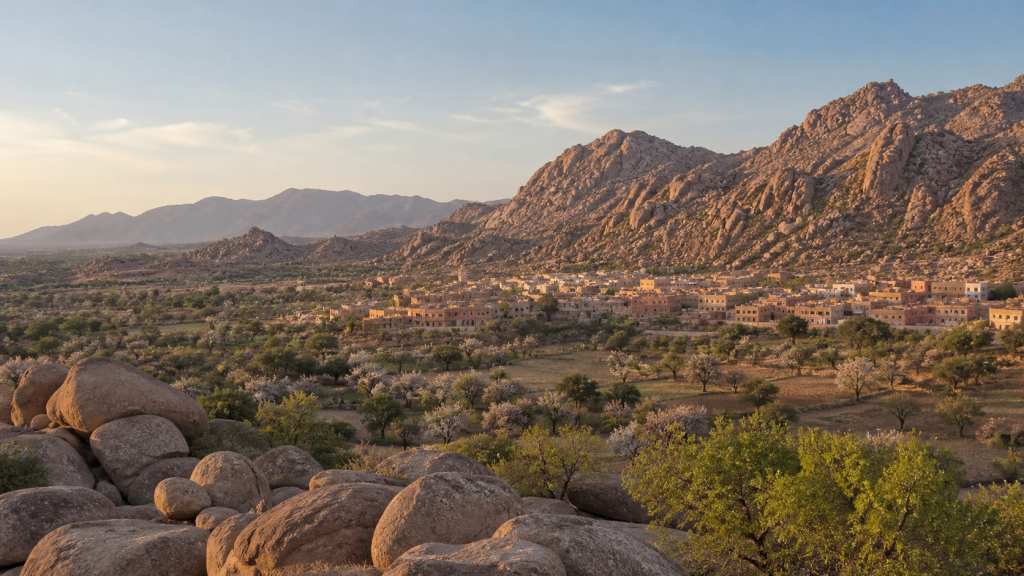
Tafraoute is not experienced like a large imperial city. This small southern Moroccan town is primarily a base from which to understand a wider landscape of mineral valleys, rose-granite boulders, Amazigh villages, argan trees and almond groves. The view changes with the hour, season and road.
Morocco’s National Tourist Office describes the Anti-Atlas as an arid range with geological, natural and cultural diversity. That combination is fragile. Distances are meaningful, shade can be scarce and services are less frequent than on the coast, so a slower journey works best.
Why Tafraoute deserves more than a day
Tafraoute’s centre provides supplies, accommodation and a starting point for outings. Most of the experience lies beyond it. Roads cross the Ammeln Valley, pass villages set against steep relief and reach rock formations that turn pink, ochre or grey as the light changes.
Two or three nights prevent the visit from becoming a chain of drives. One day can cover nearby landscapes; another can support a longer loop through villages and the Anti-Atlas countryside.
The Ammeln Valley
The Ammeln Valley lies below Jbel Lekst. Its settlements, terraces and trees reflect a long adaptation to relief and limited water. Paths, fields and water points belong to living communities; they are not empty scenery.
Stay on permitted routes, ask before photographing a person or home and do not enter private property because a door happens to be open. A local guide can explain the landscape without turning a visit into an intrusion.
Almond trees, argan trees and seasons
Late winter is associated with almond blossom, but there is no guaranteed date. Temperature, rainfall and altitude shift the calendar. Summer days can be extremely hot, while spring and autumn often provide easier walking conditions.
The argan tree is part of both the landscape and the south-western economy. Prefer products whose origin and price are clearly stated. A cooperative visit is most useful when it explains work, pay and traceability rather than simply leading to a shop.
Walking without underestimating the terrain
Walks range from short outings to demanding routes. An online track does not prove that a path is open, public or in good condition. Ask about same-day conditions, carry water, protect yourself from the sun and tell your accommodation where you are going.
After rain, passages may become slippery or affected by runoff. Mobile coverage is not uniform in the mountains. For a long outing, a guide who knows the area adds both navigation and cultural context.
Getting there and getting around
Tafraoute is reached mainly by road, including from Agadir, Tiznit or Taroudant. Journey times depend on bends, roadworks, weather and stops; a map estimate is not a guaranteed timetable.
If driving, travel in daylight and keep a sensible fuel margin. Without a car, ask an operator or your accommodation about coaches and shared taxis, then reconfirm on the day. Our guide to getting around Morocco compares the main options.
Choosing where to stay
A guesthouse in the valley may offer a closer relationship with the area; a town base simplifies meals and departures. Check access, heating in the cooler season, cooling in hot periods and whether dinner is available if the property is isolated.
Ask how water is managed. Pools, gardens and laundry matter in a dry region. An “eco-friendly” claim is more convincing when it describes specific practices.
A coherent southern route
Tafraoute can complement time in Agadir or Taroudant. The aim is not to collect stops: two well-chosen bases often create a richer trip than five towns in five nights.
Leave a buffer before a flight or long connection. Mountain roads reward patience and do not suit an overfilled schedule.
Before you leave
- Check road conditions and the local forecast.
- Carry water, sun protection and a warm layer when the season requires it.
- Download an offline map without assuming that every displayed track is public.
- Ask before photographing residents and private property.
- Use a local guide for long or poorly marked routes.
- Buy local products with transparent origin and pricing.
- Leave no waste among the rock formations.
Sources consulted
- Moroccan National Tourist Office, geography of the Anti-Atlas: https://www.visitmorocco.com/en/discover-morocco/geography-morocco
- Moroccan National Tourist Office, nature around Agadir and its hinterland: https://www.visitmorocco.com/en/travel/agadir-taghazout/nature
- Moroccan National Tourist Office, Morocco brochure mentioning Tafraoute: https://www.visitmorocco.com/sites/default/files/atoms/files/maroc-ang.pdf