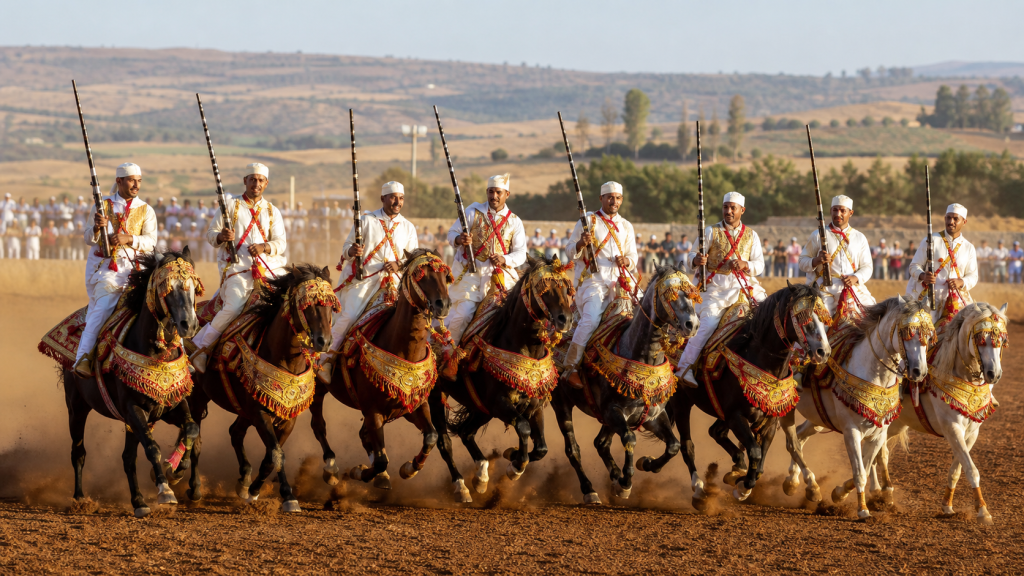
A line of horses moves forward, accelerates and carries its riders towards a gesture so coordinated that the final shots seem to become one. Tbourida is powerful, but reducing it to that loud second would erase everything that precedes it: preparation, horsemanship, dress, the troupe’s hierarchy and transmission.
UNESCO inscribed Tbourida on the Representative List of the Intangible Cultural Heritage of Humanity in 2021. The inscription concerns a living practice and the communities that sustain it. It is not a fixed show or a tourism label attached to every performance.
A practice documented over several centuries
According to UNESCO’s nomination, Tbourida dates to the sixteenth century and recreates military parades through ancestral Arab-Amazigh conventions. Its name is associated with baroud, or gunpowder, but the practice’s identity is much broader than the shot.
Troupes represent tribes or regions. Dress, horse equipment and details of performance can therefore vary. Looking for one “authentic” costume for the whole country would hide that diversity.
The sorba and its leader
A troupe, commonly called a sorba, consists of an odd number of riders and horses. UNESCO describes formations of fifteen to twenty-five, aligned with their leader in the centre.
The leader coordinates rhythm and movement. Success belongs to the whole group: horses maintaining the line, riders controlling pace and gestures converging. The most admired performance creates the impression of one collective action.
Hadda followed by talqa
The parade has two main parts. Hadda is the salute: the troupe enters at a trot, performs an acrobatic arms drill and returns to position. Talqa is the galloping charge, ending in a coordinated firing of blanks.
Knowing this structure changes how a visitor watches. Before filming the shot, notice the alignment, the leader’s signals, the gathering speed and the way each rider holds position.
Dress and horse equipment
Riders wear clothing and accessories related to their regional tradition, including draped garments, a turban, slippers and historic arms described in the nomination. Saddles and bridles are sewn and decorated through specialist crafts.
These pieces are not merely decoration. They involve tailors, embroiderers, saddlers and metalworkers. One performance can therefore bring several forms of heritage into the same movement.
Horses and responsibility
Barb and Arab-Barb horses hold an important place in the North African equestrian heritage associated with Tbourida. Safeguarding documents discuss training, veterinary care, farriery and better equipment.
For spectators, animal welfare should remain part of the decision to attend. A striking image cannot replace water, rest, suitable tack and organisation that accounts for heat.
Family and collective transmission
UNESCO highlights transmission from generation to generation within families, through oral tradition and observation. Learning means watching experienced riders, working with horses and absorbing the troupe’s rules.
Safeguarding therefore means more than scheduling large festivals. It requires training spaces, associations, craftspeople, healthy horses and routes for new practitioners to enter the tradition.
Where to see it without inventing a calendar
Tbourida is performed at moussems, festivals, celebrations and competitions in different parts of Morocco. Dates and programmes change. Confirm with the organiser, municipality, region or an equestrian institution before building a trip around an event.
Arrive early, respect safety areas and never cross the track. The rounds use blanks, but the horses’ speed, the sound and the crowd still require serious organisation.
Photographing respectfully
Stay in public areas and follow instructions. A longer lens helps maintain distance. Ask before making a close portrait away from the track, especially during preparation or prayer.
Avoid captions that turn riders into participants in a modern battle. Tbourida is a heritage performance rooted in regional histories and present-day communities.
For a broader context, read our articles on rituals and celebrations in Morocco and Moroccan cultural festivals.
Sources consulted
- UNESCO, “Tbourida”, file 01483 and the 2021 inscription decision: https://ich.unesco.org/en/RL/tbourida-01483
- UNESCO, nomination and safeguarding documentation: https://ich.unesco.org/doc/src/49273-FR.pdf
- Moroccan National Tourist Office, cultural presentation of Tbourida: https://www.visitmorocco.com/en