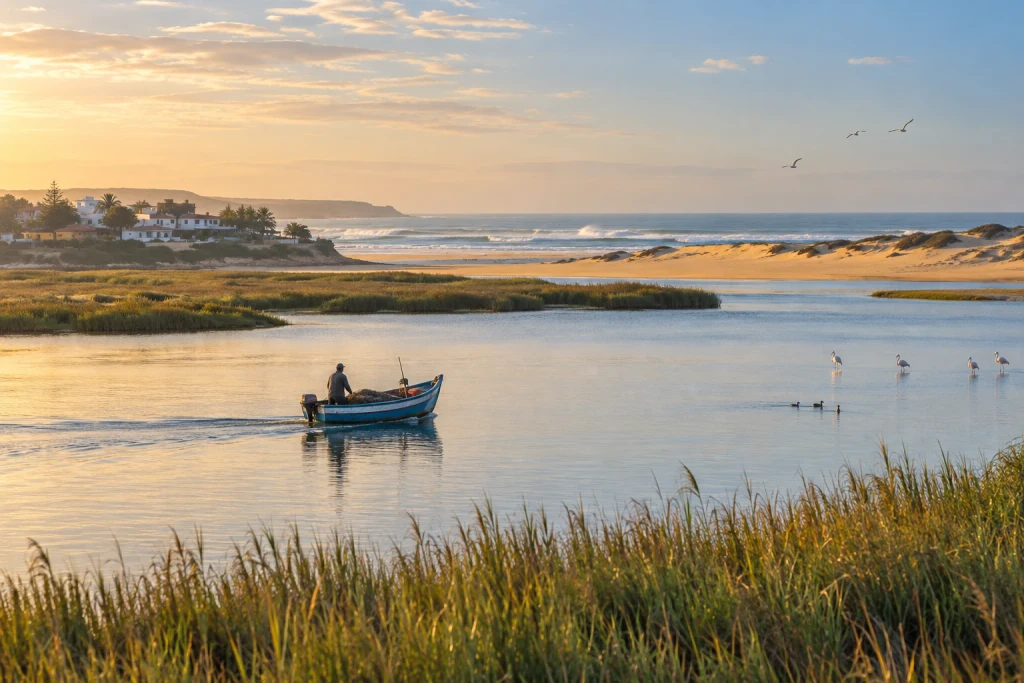
The Atlantic is always close at Moulay Bousselham, but the Merja Zerga lagoon sets the pace. Water, sandbanks, reeds, birds and fishing activity form a living landscape that feels different from a conventional seaside stop.
The wetland is listed as internationally important under the Ramsar Convention. Its official information sheet, updated in 2025, records an area of 7,300 hectares and a designation date of 20 June 1980. Those facts explain the site’s significance; they do not turn it into an attraction or guarantee a wildlife sighting at any hour.
Understand the link between village and lagoon
Moulay Bousselham lies immediately north of Merja Zerga. The village provides access to the coast, daily services and possible boat departures, while the lagoon occupies a depression separated from the ocean by a belt of dunes.
An opening to the Atlantic renews the water and constantly changes the view. Tide, wind and light influence what is visible. It is more useful to reserve unhurried time than to build a checklist of fixed viewpoints.
A lived wetland, not an empty backdrop
Ramsar documentation describes a place important for biodiversity, but also for fishing, agriculture and neighbouring communities. A boat on the water is not merely picturesque: it may be a working tool in a shared environment.
That reality calls for observation without interference. A good outing is not measured by how many birds were approached or how close the boat came, but by the guide’s knowledge, respectful distances and the time allowed for the landscape to unfold.
Choose a season without promising a spectacle
Migratory birds are central to Merja Zerga’s reputation, particularly during certain passage and wintering periods. Their exact presence still depends on season, weather, water levels and other natural factors.
Before booking an outing, ask what can reasonably be observed during your stay, how long the trip lasts and what conditions determine departure. A responsible operator should be comfortable explaining uncertainty rather than guaranteeing a species or scene.
Plan half a day or stay overnight
Half a day can include the village, a view from the shore and, when conditions allow, a short trip on the water. An overnight stay gives greater freedom to choose softer light and avoid compressing every experience into one hour.
The plan can remain simple: walk, eat locally, listen to current advice and leave a margin. The beach and ocean add another atmosphere, but swimming, swell and currents must always be assessed locally.
Go onto the water with care
Before boarding, check the boat’s stability, passenger number, suitable equipment and the experience of the person in charge. Timings and routes should respond to tide and wind.
A boat should never chase birds or cross a resting area. Keeping voices low, limiting sudden movements and accepting a distant view protect the wetland and make the encounter more honest.
Photograph without turning the lagoon into a stage
A longer lens helps maintain distance. Avoid recorded calls, gestures designed to make a flock take off, or positions that force a fisher or resident to change what they are doing.
The most faithful photograph may show the relationship between water, dunes, work and migration rather than a dramatic close-up. Always ask permission before framing an identifiable person.
Connect the stop with a wider journey
The Ramsar sheet places Merja Zerga in the Rabat-Salé-Kénitra region, south of Larache. This makes it a possible pause on an Atlantic route between northern cities and Rabat, but road times and available transport should be checked for the chosen date.
Avoid a tight connection immediately after a boat trip. A change in weather or tide can make a rigid plan impractical. The value of this stop lies precisely in the space it creates.
Leave room for the wetland after you go
Take waste away, limit light plastic that wind can carry and stay on established passages. Wetlands concentrate delicate balances that ordinary actions can disturb.
Moulay Bousselham and Merja Zerga make more sense as a shared territory than as an isolated attraction. Slow down and the lagoon’s beauty begins to include its everyday uses as well as its broad horizons.
Continue along the Atlantic with MOP’s responsible guide to Lixus and Larache or a slower stop farther south beside Oualidia lagoon.