Travelling alone in Morocco can offer great freedom: choosing your own pace, extending an encounter or changing a stop. This does not mean ignoring risks or viewing every interaction as a threat. Practical preparation helps distinguish between hospitality, persistent selling, harassment and a genuinely dangerous situation.
Safety advice should be adapted to the city, time, neighbourhood and activity. No guide can guarantee that no incident will occur. The aim is to reduce exposure, recognise your limits and retain a backup option.
Preparing for the first twenty-four hours
Book the first night in clearly identified accommodation and ask for precise access instructions. If you are arriving late, arrange a transfer with the accommodation or a verifiable operator. Knowing the driver’s name, the price and the meeting point reduces the number of decisions you need to make while tired.
Download the map, address and riad’s phone number. In a medina, a taxi may stop before reaching the door; ask whether someone will meet you at the drop-off point.
Send your itinerary to someone you trust and agree to send an arrival message. This sharing does not need to become constant monitoring: a simple check-in is enough to trigger a check if you do not respond.
Choosing accommodation based on actual access
Reviews can help, but read those from solo female travellers and recent comments about access at night, the welcome and the neighbourhood. A high overall rating does not answer questions about the alleyway between the taxi and the door.
Ask whether reception remains open, who has the keys and how to return after going out. Check that there is a working interior lock and secure storage.
Do not publicly share your room number or exact dates. If someone asks where you are staying without a practical reason, a vague answer is enough.
Getting around with clear reference points
Choose official taxis or an organised transfer. Before a negotiated journey, confirm the price and destination. Follow the route on a map if that reassures you, without giving the impression that you are completely unfamiliar with the neighbourhood.
For intercity travel, a train or scheduled coach avoids having to depend on a driver found at the last minute. Arrive during the day when the destination is new to you.
The guide https://www.lemarocouvresesportes.com/en/getting-around-morocco-train-bus-taxi-car/ details the options. If you are driving, avoid isolated stops and consult https://www.lemarocouvresesportes.com/en/driving-morocco-licence-tolls-fuel-safety/
Harassment: setting a boundary without negotiating
France Diplomatie notes that women travelling alone may receive persistent attention that can amount to harassment. A short, firm refusal is enough. You do not have to justify your choice, smile or continue a conversation.
If the person persists, go into a shop, move closer to a family or ask an identifiable official for help. Change direction towards a busy place rather than an empty alleyway.
A fictitious wedding ring or an invented story can sometimes end a conversation, but it should not become the only strategy. Responsibility for the behaviour lies with the harasser, not the traveller.
Clothing and local customs without blame
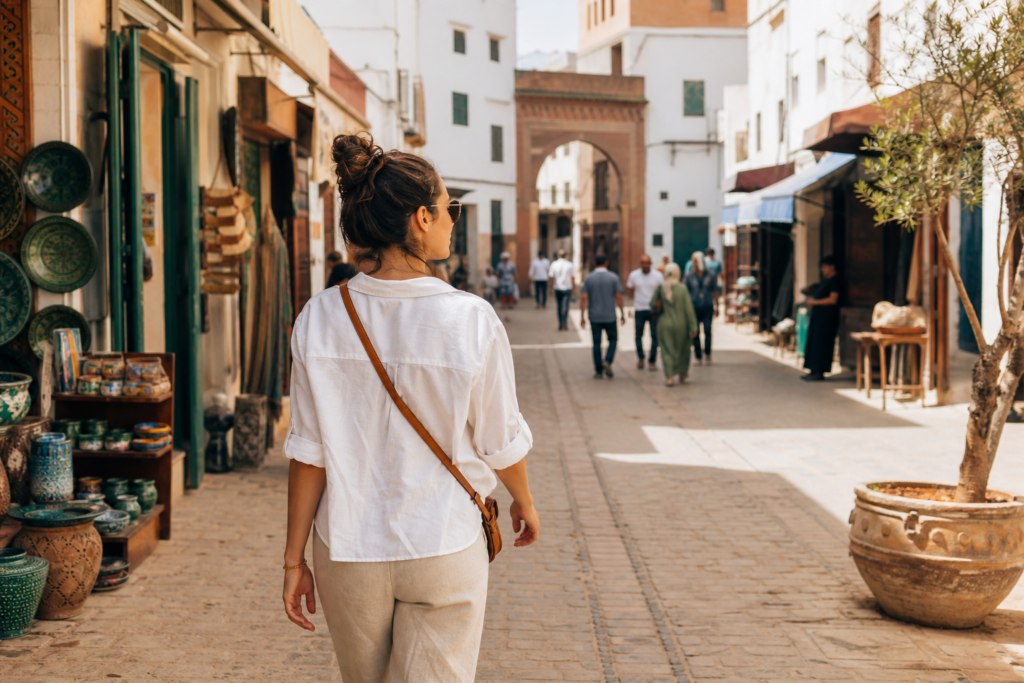
Morocco is diverse: an outfit considered ordinary in Casablanca may attract more attention in a conservative village. Choosing comfortable and relatively covering clothing can make some interactions easier, enable you to visit a religious site or protect you from the sun.
This does not mean that clothing causes harassment. People remain responsible for their actions. Cultural adaptation is a practical and respectful choice, not a promise of safety.
Bring a light layer for your shoulders, air conditioning and cool evenings. Follow the rules displayed at the sites you visit.
Going out in the evening while keeping a way back
Before going out, decide how you will return. Ask the accommodation to book a taxi or note the location of an official taxi rank. Avoid walking alone on beaches, in parks, along deserted streets and in poorly lit areas at night.
Keep your phone charged, a small amount of money separate and the accommodation’s address with you. Watch your drink and do not accept it if it has been out of your sight.
If a situation becomes uncomfortable, leave without waiting to prove that your intuition was correct. An additional taxi fare is better than feeling obliged to stay out of politeness.
Guides, invitations and encounters
An official guide or identifiable operator provides a programme, price and contact details. Someone who approaches you spontaneously may be sincere or may expect payment. Clarify the situation before accepting a tour, invitation or extended assistance.
For a first meeting, choose a public place and retain your own means of getting back. Do not accompany someone to an isolated place simply because refusing seems impolite.
An invitation from a family can become a wonderful memory. Nevertheless, tell someone you trust, ask for the address and retain the freedom to leave.
Money, phone and documents
Keep two payment methods separate and have only the amount needed for the day accessible. Do not display all your cash when making a purchase. Our guide https://www.lemarocouvresesportes.com/en/money-morocco-currency-cards-cash-tipping/ explains currency exchange and withdrawals.
Keep your passport in a safe place when the original is not required and carry a copy depending on the context. Save documents in a protected location, not in a gallery accessible from the lock screen.
A SIM or eSIM keeps navigation and calls available. Prepare it with https://www.lemarocouvresesportes.com/en/sim-esim-internet-morocco/ and also download data for offline use.
Digital security and dating apps
Avoid posting your real-time location on a public account. Delay posts and conceal booking numbers, boarding passes and room details.
On a dating app, do not quickly move the conversation to a channel that reveals your main phone number. Choose a busy place, tell someone and arrange your return independently.
A VPN can protect a shared Wi-Fi network, but it does not verify the identity of the person you are talking to. Use two-factor authentication and immediately block a persistent account.
Hiking, beaches and isolated areas
An excursion in the Atlas Mountains or the desert requires a verifiable guide and operator. Mobile coverage may disappear, and rescue capabilities are limited in some areas. Share the route and expected return time.
On the coast, choose busy, supervised areas. Atlantic currents can be powerful. Avoid visiting an isolated beach alone, particularly at nightfall.
Do not follow a stranger to a “secret viewpoint” without knowing the route. A beautiful photograph does not compensate for a journey with no clear way back.
What to do if an incident occurs
In immediate danger, go to a busy place and call the emergency services: police 19, emergency medical services and fire brigade 15, gendarmerie 177 according to official sources. Give your location, a landmark and your phone number.
After theft, assault or fraud, preserve the evidence and request an official document. Contact your insurer and, if you are a foreign national, the relevant consulate. A platform may also require a separate report.
Do not minimise a problem because the trip must continue. Take the time to get to safety, speak to someone you trust and adapt the rest of your plans.
Travelling alone without always being on the defensive
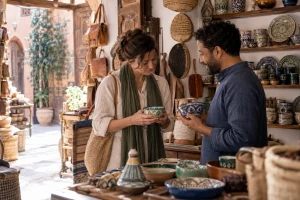
Preparing responses and ways to return frees up attention for the trip. In a café, workshop or train, many conversations are simply warm and friendly. Being cautious does not require refusing every interaction.
Keep control over the place, duration and means of leaving. When these three elements are clear, a spontaneous encounter is easier to enjoy.
Morocco can be reduced neither to a risk-free image nor to a succession of dangers. A nuanced perspective makes it possible to travel there independently.
Checklist before a day alone
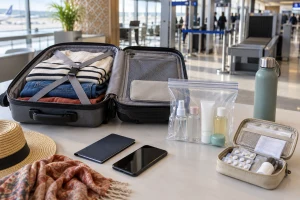
- Charged phone, offline map and return address.
- Main payment method and reserve kept separate.
- Return transport identified before going out late.
- Itinerary or check-in shared with someone you trust if the activity is isolated.
- Simple refusal prepared for persistent approaches.
- Emergency and assistance numbers accessible.
- Guide or operator verified for mountains, desert and high-risk activities.
- Freedom to change your plans as soon as a situation becomes uncomfortable.
Official sources consulted
- France Diplomatie, safety in Morocco, updated 7 August 2026: https://www.diplomatie.gouv.fr/fr/information-par-pays/maroc/conseils-aux-voyageurs-securite
- France Diplomatie, useful contacts in Morocco: https://www.diplomatie.gouv.fr/fr/information-par-pays/maroc/conseils-aux-voyageurs-contacts-utiles
- France Diplomatie, health in Morocco: https://www.diplomatie.gouv.fr/fr/information-par-pays/maroc/conseils-aux-voyageurs-sante
- Moroccan Ministry of Health, emergency numbers: https://www.sante.gov.ma/urgences/Pages/default.aspx
- Moroccan National Tourist Office, practical information: https://www.visitmorocco.com/fr/