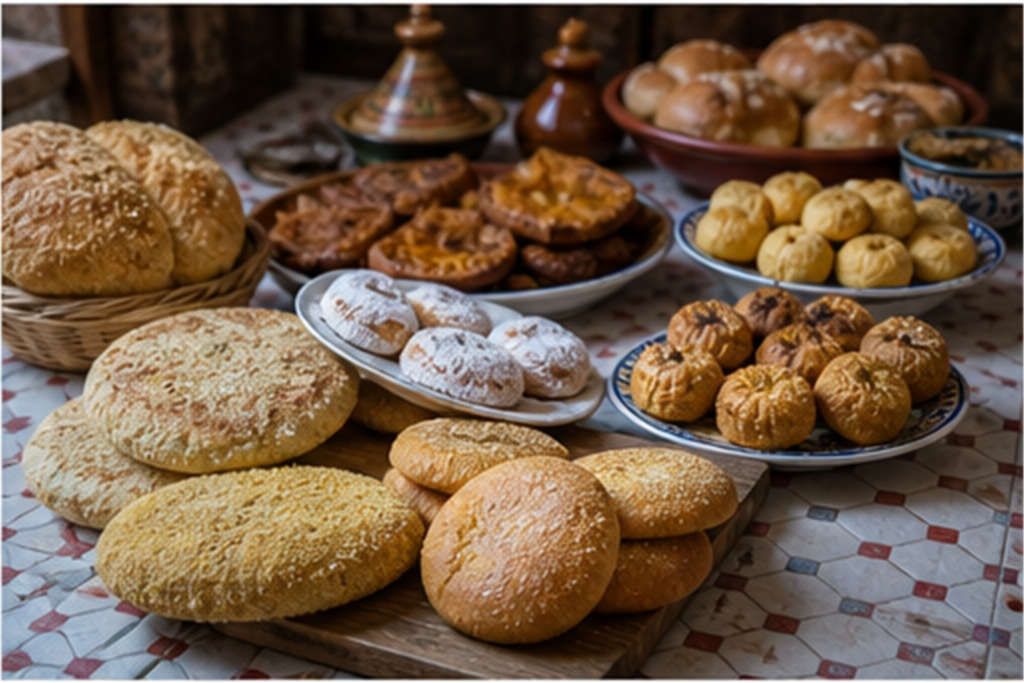
In Morocco, bread accompanies meals, is used to scoop up sauce, holds fillings and embodies gestures of hospitality. Pastries are part of everyday life, served with tea, but also appear during festivals, weddings and religious periods. Between the two are pancakes, flatbreads and layered doughs that make the categories less rigid.
The same name can refer to several recipes depending on the city, family or bakery. Rather than looking for a single “authentic” version, observe the flour, fat, fermentation, shaping, cooking method and occasion.
Khobz, the everyday bread
Khobz commonly refers to a round, relatively flat loaf baked in an oven. Wheat flour, semolina or blends produce different crumbs, crusts and colours. Seeds may be included depending on the recipe.
Sometimes the dough is prepared at home and then sent to the neighbourhood bakery. Markings or the basket help identify the loaves. This system connects domestic cooking with communal facilities.
Do not judge bread solely by how warm it is. Look at the cleanliness of the point of sale, turnover and storage. If you have an allergy, ask specifically about the flours and seeds, without assuming there is no cross-contamination.
Msemen, layers and griddle cooking
Msemen is a dough folded into layers, generally cooked on a griddle. It can be served with honey, butter, cheese or a savoury filling. Its texture depends on the kneading, folding and amount of fat.
It is eaten at breakfast, as a snack and on the street. When preparation is visible, you can observe the technique, but ask before filming the person at work.
Eat it hot when turnover is clear. If a filling contains meat or cheese, storage conditions are just as important as the final cooking.
Baghrir, the thousand-hole pancake
Baghrir is a semolina pancake whose surface becomes covered with small holes as it cooks. It is generally cooked on one side only and readily absorbs melted butter and honey.
The number “thousand” describes its appearance, not an actual count. Fermentation and the consistency of the batter determine how the holes open. Modern recipes sometimes use both baker’s yeast and baking powder.
Taste it plain before adding a lot of syrup: the texture and slight fermentation become more noticeable.
Harcha, semolina and a crumbly texture
Harcha is a semolina flatbread cooked on a griddle. It has a crumblier texture than msemen and can be divided into portions. Butter, milk or oil vary depending on the recipe.
It is often served with tea, honey, jam or cheese. In some cafés, a small harcha is cooked or reheated to order; elsewhere, large flatbreads are cut into pieces.
Ask whether it was prepared that day. A dry texture may be due to the recipe or a long wait: the seller will be able to explain.
Batbout and pan-cooked breads
Batbout is a small leavened bread cooked in a pan or on a griddle. It forms a pocket and is well suited to fillings. Its size ranges from an individual loaf to small buffet pieces.
Stuffed versions may contain vegetables, meat, tuna or cheese. For a vegetarian, the name alone is not enough: ask about the filling and cooking method.
When travelling, one prepared in front of you can make a practical meal. Check the sauces, raw vegetables and storage, especially in very hot weather.
Chebakia and the month of Ramadan
Chebakia is a shaped, fried pastry coated in honey and often sprinkled with sesame. It is strongly associated with Ramadan and accompanies harira when breaking the fast.
Shaping it requires a precise technique; spices and orange blossom water vary. Strong seasonal demand leads to an increase in both family workshops and commercial production.
Buy an appropriate quantity: the honey and frying make the pastry rich. Ask how it should be stored and use a box rather than fragile packaging.
Gazelle horns and almond craftsmanship
Gazelle horns, kaab el ghzal, wrap fragrant almond paste in a thin pastry. They are associated with receptions and celebrations, but are also sold in pastry shops.
The proportion of almonds, the thinness of the outer layer and the fragrance explain major price differences. A very inexpensive product may use a different filling; ask about the ingredients.
People with allergies must consider almonds, sesame, peanuts and cross-contamination. An elegant display case does not constitute a medical guarantee.
Ghriba, fekkas and biscuit families
Ghriba refers to several round or cracked biscuits made with almonds, sesame, coconut, flour or other ingredients. Fekkas is sliced and baked again, often with almonds or raisins.
These biscuits travel well and keep better than cream-based preparations. They make a simpler souvenir, provided that the customs rules of the destination country are respected.
Ask for a small assorted box to compare them. The name alone does not indicate the texture, sugar content or allergens.
Regional and family variations
The north, the Souss, the Atlas Mountains, the imperial cities and the oases have their own cereals, dried fruits, oils and customs. Barley breads, aniseed preparations, and recipes made with saffron or dates appear depending on available resources.
Internal migration also spreads specialities. A recipe bought in Casablanca may come from a family from the Rif or Souss. The city where it is sold is therefore not always its claimed origin.
Ask “how do you prepare it here?” rather than “what is the real recipe?”. The answer will be more precise and less contentious.
Buying, tasting and photographing
Choose a busy shop, observe turnover and ask for the price by weight or per item. For an assortment, confirm the total before it is packaged.
Bring a reusable box if the seller accepts it. Avoid touching the products and let the staff use tongs or paper. For payments, our guide to money in Morocco provides useful guidance.
Ask before photographing the workshop. Credit the pastry shop or craftswoman when sharing a technique, and do not publish a recipe you observed as if you had created it.
Culinary reference points
- Khobz: round bread for everyday meals.
- Msemen: layered dough cooked on a griddle.
- Baghrir: semolina pancake with small holes.
- Harcha: crumbly semolina flatbread.
- Batbout: pan-cooked leavened bread, often filled.
- Chebakia: fried pastry with honey and sesame.
- Kaab el ghzal: delicate almond pastry.
- Ghriba and fekkas: biscuit families with many variations.
Sources consulted
- Moroccan National Tourist Office, Moroccan cuisine: https://www.visitmorocco.com/en/discover-morocco/gastronomy
- UNESCO, knowledge and practices related to couscous, North African food context: https://ich.unesco.org/en/RL/knowledge-know-how-and-practices-pertaining-to-the-production-and-consumption-of-couscous-01602
- National Office for Food Safety: https://www.onssa.gov.ma/
- Ministry of Youth, Culture and Communication, intangible heritage: https://mjcc.gov.ma/