Argan is often presented to travellers as an oil to take home. That commercial reading is too narrow. In 2014 UNESCO inscribed “Argan, practices and know-how concerning the argan tree” on the Representative List of the Intangible Cultural Heritage of Humanity.
The element concerns knowledge, techniques, uses and transmission in south-west Morocco. It asks us to see the living system around the tree rather than reduce heritage to a bottle.
Place the argan tree in its territory
UNESCO describes the argan tree as an endemic woodland species found in the Arganeraie Biosphere Reserve in south-west Morocco. Territory, communities and ecological conditions therefore belong to the context.
Seeing a tree beside a road is not enough to understand the practices. A documented journey connects landscape, collection, household or collective work and local uses without turning an entire region into a production set.
Follow the sequence of techniques
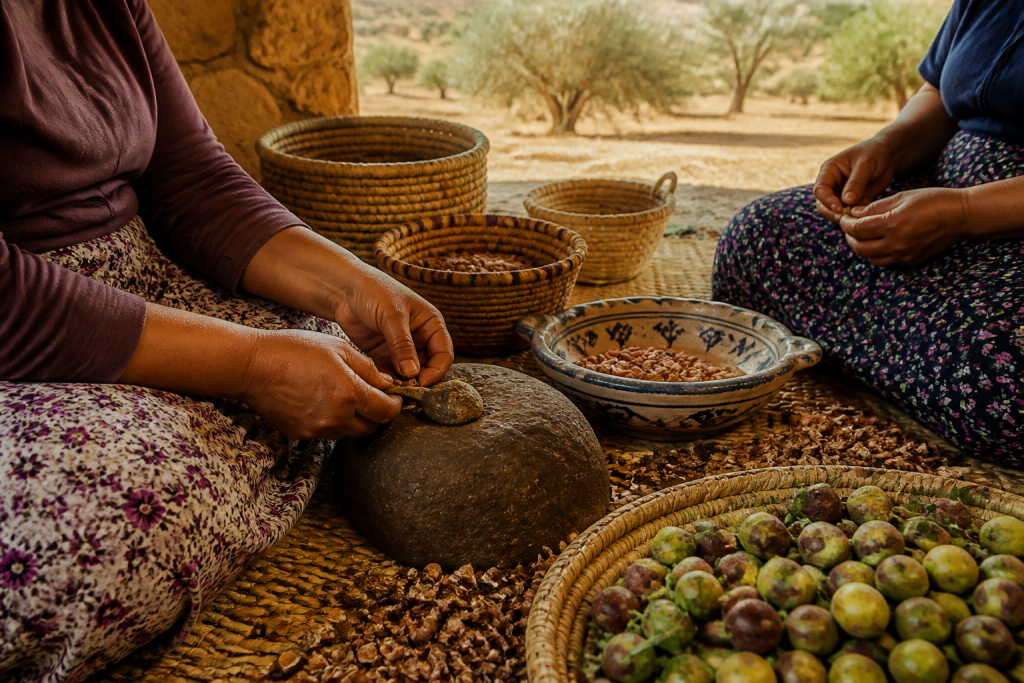
The official description lists harvesting, drying, pulping, grinding, sorting, milling and mixing. These operations require different skills and rhythms. They cannot be reduced to a demonstration lasting a few minutes.
During a visit, ask which stages are genuinely carried out on site. A demonstration may be educational, but it does not on its own prove the origin of every raw material or the conditions of the whole production chain.
Understand transmission
UNESCO notes that knowledge is passed on through imitation and non-formal learning. This transmission gives the heritage continuity. It does not mean that every practice is fixed or identical across all communities.
Listening to practitioners and accepting varied answers is more accurate than seeking one definitive story. Living heritage changes with social, economic and environmental conditions.
Separate uses from unsupported claims
The official file refers to culinary and cosmetic uses as well as wood. It does not turn every product on sale into a medical treatment or guarantee its composition.
Avoid repeating unsupported health promises. Read cosmetic ingredient lists and check food labelling and storage instructions. A cultural story is not a substitute for product information.
Recognise women’s work without fixing roles
The inscription decision highlights women’s contribution and the social role of the practices. That work deserves recognition without trapping communities in a folkloric image or assuming that every organisation has the same structure.
At a cooperative or workshop, ask who produces, processes, sets prices and receives income. If these answers are unavailable, do not invent them in a travel story.
Buy using verifiable criteria
Start with the intended use: food or cosmetics. Check ingredients, volume, packaging, the producer or distributor and required information. Craft-style packaging and a warm sales pitch are not certifications.
Compare without aggressive bargaining and request a receipt where possible. If quality, origin or fair-trade status is claimed, look for the corresponding label or record instead of repeating it automatically.
Connect heritage and sustainability
UNESCO’s committee noted the element’s role in conservation, ecological management, social cohesion and sustainable development. Recognition does not remove the need to examine the real practices behind an operator or product.
A responsible visit limits unnecessary movement in fragile areas, follows local instructions and clearly pays for an organised service. It never removes fruit or branches without permission.
Prepare a respectful encounter
- Ask whether the visit is organised and paid.
- Photograph people only with their agreement.
- Separate an educational demonstration from full production.
- Check labels before purchasing.
- Do not repeat undocumented medical claims.
- Respect the landscape and harvesting rules.
MOP’s Tafraoute and Anti-Atlas travel guide helps place part of this territory without reducing the region to one product.
Sources consulted
- UNESCO, “Argan, practices and know-how concerning the argan tree”: file 00955
- UNESCO, inscription decision 9.COM 10.30: official decision