Henna is often seen as a pattern applied to the hands. That image shows only one part of a wider practice: growing the plant, harvesting leaves, drying, grinding, mixing paste, decorative repertoires, songs, stories and social occasions.
In 2024, UNESCO inscribed “Henna: rituals, aesthetic and social practices” on the Representative List of the Intangible Cultural Heritage of Humanity. The file associates Morocco with fifteen other States. It is therefore important to recognise a shared practice while observing its local expressions.
A plant before it becomes a pattern
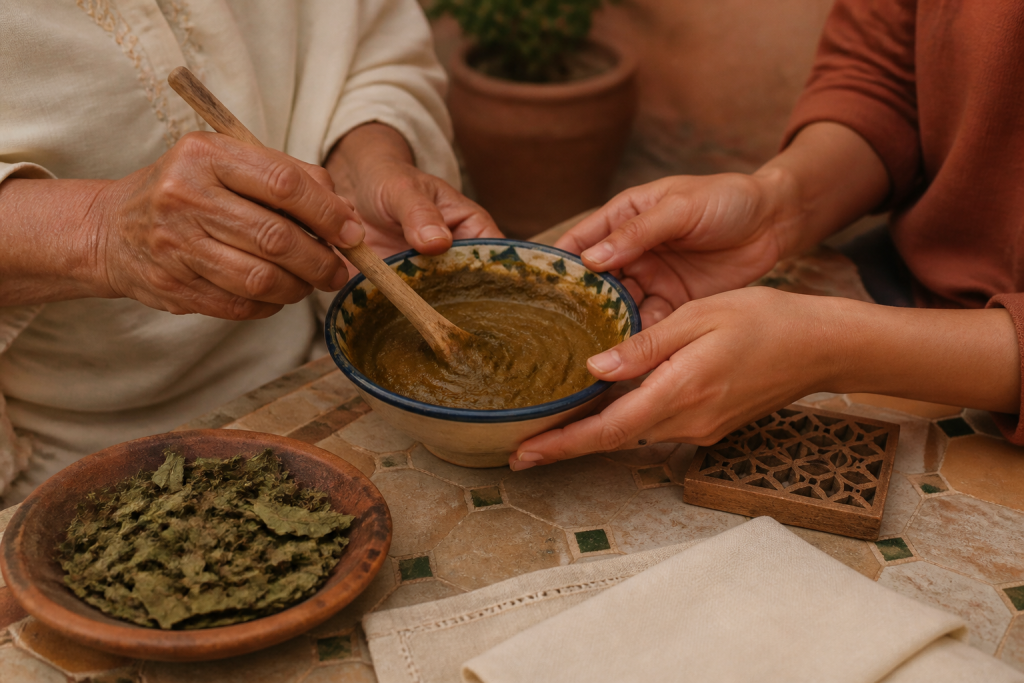
UNESCO describes a deciduous tree grown in hot regions. Its leaves are harvested, dried and ground before being made into a paste. Ingredients and techniques vary according to the country, community and intended use.
This material chain matters as much as the finished design. It connects agricultural knowledge, understanding of texture, proportion, resting time and control of the hand. Presenting henna only as a ready-made product removes much of the heritage.
Everyday and festive occasions
Henna is associated with joy and can accompany births, weddings and other moments in social life. It is also used for adornment in less ceremonial settings. The precise meaning depends on the family, region and occasion.
There is no universal design carrying the same message everywhere. Asking the practitioner what she intends to express is more accurate than automatically assigning symbolism found online.
Knowledge often passed on through practice
The UNESCO file emphasises family and community transmission through observation and hands-on practice. A learner recognises the material, prepares the paste and controls the tool by watching and repeating gestures alongside experienced practitioners.
Associations, centres, universities and media also contribute today. This wider participation can help document knowledge, but it does not replace the communities that give the ritual its social context.
Songs, words and encounters around the gesture
The practice may be accompanied by songs, proverbs, poems and conversation. Application time then becomes a relational space. The person receiving the design is not merely a surface, and the practitioner is not an anonymous tool.
This explains why a silent photograph cannot tell the complete story. Rhythm, words, expectations and group participation form part of the experience even when they leave no visible trace.
Observe without staging people
At a private ceremony, a visitor’s presence does not create permission to take photographs. Ask the people concerned before recording or publishing an image. Consent for a personal photograph does not necessarily include social-media use.
In a workshop or commercial setting, clarify the price, duration and proposed service before starting. A demonstration can be cultural and economic at the same time; that does not diminish the skill when the exchange is transparent.
Do not turn heritage into a medical promise
The international file mentions craft and medicinal uses within some communities. A heritage description is not health advice. Paste applied to the skin may have different ingredients from one place to another.
A person who is pregnant, allergic, receiving treatment or has a skin condition should seek appropriate health advice. MOP recommends no product or mixture and does not present tradition as proof of effectiveness or safety.
Choose a responsible encounter
A credible workshop explains the material, duration, price and identity of the practitioner. It does not force an exotic story or promise origin and purity without evidence. A visitor can also choose to observe without receiving an application.
Commerce can support the practice when pay and authorship are visible. It weakens the practice when work is anonymised, copied without attribution or treated as a photographic accessory.
What the UNESCO inscription means
The 2024 inscription recognises living knowledge and practices shared by several countries. It does not make every henna service UNESCO-certified and does not create a commercial quality label.
Its value is to direct attention towards practitioners, transmission and social functions. Heritage evolves because it is practised, discussed and adapted, not because it is frozen in one form.
Reference points for visitors
- Ask permission before photographing or publishing.
- Clarify price, duration and composition with the practitioner.
- Do not assign universal meaning to every pattern.
- Reject unsupported medical promises.
- Recognise authorship and the value of the practitioner’s time.
- Accept that a private ceremony is not an attraction.
For another view of living skills, MOP’s guide to the Moroccan caftan also separates the object from the gestures and transmission that sustain it.
Sources consulted
- UNESCO, “Henna: rituals, aesthetic and social practices”, 2024 inscription: official file 02116
- UNESCO, decision of the Intergovernmental Committee 19.COM 7.B.15: official decision