
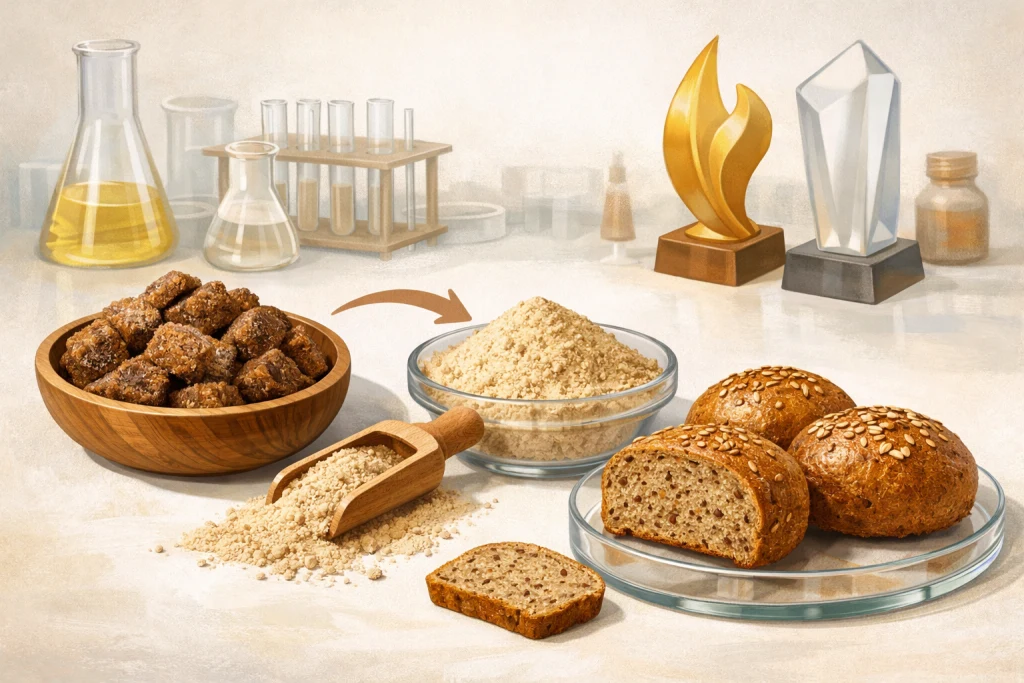
A Mohammed V University research team received two distinctions at the 2026 World Young Scientist Summit in Wenzhou, in China’s Zhejiang province, according to Maroc.ma. The recognized work concerns the use of press cake left from argan oil production in food innovation. It highlights Moroccan university research exploring how a by-product of argan processing could, after specific treatment, serve as an ingredient in experimental bread formulations.
Maroc.ma attributes the best scientific paper award to Badr Eddine Kartah, Asma El Kaourat and Hanae El Monfalouti, and the best oral presentation award to Kartah. The available Chinese reporting confirms Kartah’s participation, his affiliation with the Mohammed V University Faculty of Sciences and his presentation about argan seed oil cake and food innovation. It does not, however, provide an independent winners list for either of the two reported award categories.
A summit focused on young researchers
The main summit proceedings took place in Wenzhou on October 24 and 25, 2026. According to the Chinese overview of the event, nearly 800 participants from more than 60 countries and regions attended. Those figures place the Moroccan presentation within a substantial international scientific gathering, although they do not offer additional confirmation of the specific award categories described by the Moroccan official report.
The summit theme was “Gathering Talents Worldwide to Create a Better Future,” while its program emphasized youth-led innovation and international cooperation. The Moroccan project fits that broad focus because it explores a possible food use for a by-product of argan oil production. Its presence at the event should nevertheless be distinguished from the maturity of the underlying work, which remains experimental research described in a peer-reviewed article.
What the scientific study actually tested
The work is based on a peer-reviewed article titled “Pre-Treatment Effects on Chemico-Physical Characteristics of Argan Press Cake Used for Bread Production,” published in Foods on April 10, 2025. Its eight authors are Asma El Kaourat, Hasnae Choukri, Badr Eddine Kartah, Ahmed Snoussi, Giuseppe Zeppa, Aouatif Benali, Mouna Taghouti and Hanae El Monfalouti. The paper examines defined pretreatment methods and the subsequent use of the material in experimental bread.
The researchers applied two separate processes to argan press cake in an effort to reduce its saponin content. One treatment used a hot citric-acid solution, while the other used hot distilled water. The resulting materials were then incorporated into whole-wheat flour as partial substitutes. This design allowed the team to compare treated ingredients and assess their characteristics within controlled bread formulations rather than in a commercially established product.
Four substitution levels were evaluated: 5%, 10%, 15% and 20% treated argan press cake in the composite flours. The range enabled researchers to examine how measured properties changed as the proportion increased, but it does not mean that every level performed equally. The study concerns these specific experimental formulations and does not establish retail availability, industrial adoption, regulatory approval, consumer demand or clinical benefits for people eating the resulting bread.
Nutritional and technological findings in context
The paper reports that both treatments significantly lowered saponin content while retaining nutritional quality comparable to untreated argan press cake. The authors also measured a 50% reduction in phytic-acid levels following treatment. These findings describe changes in the material produced under the study’s conditions. On their own, they do not demonstrate a health outcome in consumers, and the authors frame the process as a potential approach to nutritional enhancement rather than an established clinical intervention.
Increasing the share of treated argan press cake also raised the protein content of the composite flours in a level-dependent manner. For the bread’s technological properties, the reported positive effects applied at substitution levels of up to 10%. The available evidence therefore does not support extending that conclusion automatically to the 15% and 20% formulations, even though both higher levels were included among the experimental conditions assessed by the researchers.
A reuse pathway, not yet a commercial product
The authors present the approach as a potential method for improving nutritional composition and reusing a by-product of argan oil production. That wording defines the study’s practical limits: it assesses treatments and experimental recipes but does not establish that the bread is available to the public. The evidence also provides no basis for claiming regulatory clearance, industrial-scale adoption, demonstrated consumer demand, commercial distribution or a timetable for launching a finished product.
Maroc.ma additionally reports that the research resulted in a Moroccan patent registered with OMPIC. The accessible information does not include an application or publication number, a filing date or the patent’s claims. Its precise record and scope therefore cannot be examined from the available material. The reported registration should also not be treated as evidence that the method has entered production or that a corresponding bread has reached the market.
What still needs confirmation
The two distinctions currently rest on the account published by Maroc.ma, while the available Chinese sources mainly corroborate Badr Eddine Kartah’s participation and the subject of his presentation. An official winners record or named certificates would provide separate confirmation of the best scientific paper and best oral presentation categories, including the three researchers associated with the paper award. This limitation does not affect the documented existence of the peer-reviewed study published in 2025.
The next meaningful evidence would include the announced patent’s identifier and information about any steps beyond laboratory testing. Documentation of pilot-scale production, regulatory assessment, industrial adoption or market introduction would be needed before describing the research as an available food innovation. For now, the record supports two reported distinctions, confirmed participation in Wenzhou and promising experimental findings whose relevance remains bounded by the methods and substitution levels examined in the study.