A caftan often draws attention first through silhouette, colour and light caught by its decoration. The finished garment, however, tells only part of the story. Behind it is a chain of knowledge: producing or selecting fabric, planning the cut, assembling, braiding, making buttons and building the ornament.
In December 2025, UNESCO inscribed “Moroccan Caftan: art, traditions and skills” on the Representative List of the Intangible Cultural Heritage of Humanity. The recognition is less an invitation to place the garment behind glass than to notice the people, learning and social uses that keep it alive.
A garment for significant occasions
UNESCO describes the caftan as a long tunic worn by people of all genders and ages for celebrations and special occasions. Its account includes weddings, baptisms, coming-of-age rituals and festivals among those settings.
Styles and fabrics vary, and a caftan may be worn with or without a decorative belt. That diversity makes it impossible to reduce the garment to one official design, one colour or one timeless image.
Read the structure before the ornament
The central opening, buttons, cut and way the fabric falls establish the overall balance. Decorations may include embroidery, beads and sequins, but their effect depends on their relationship with material and proportion.
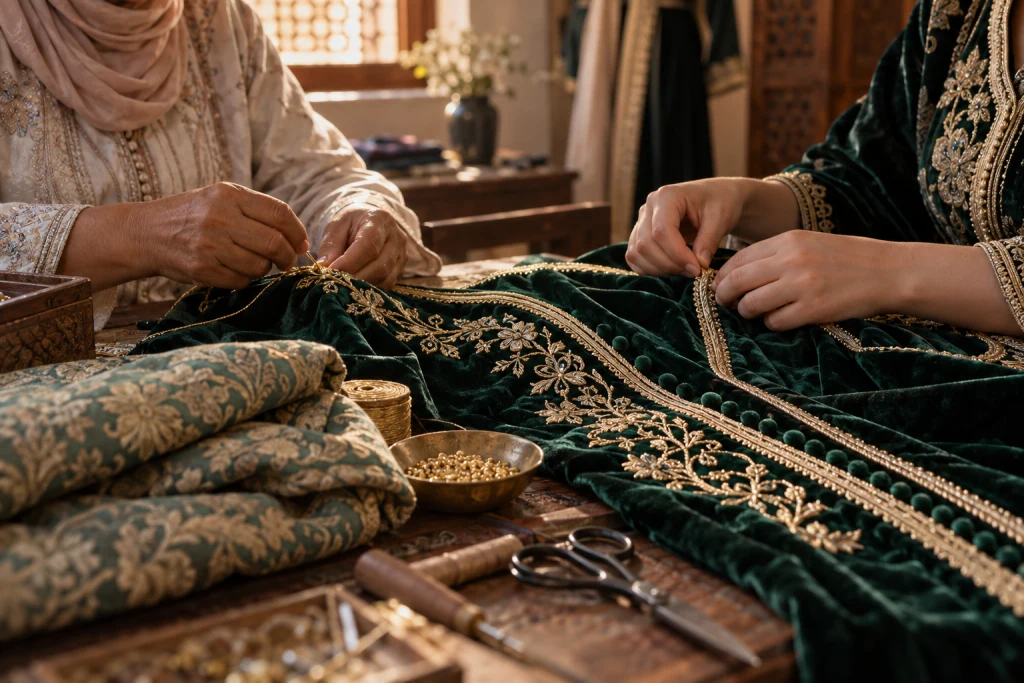
Looking slowly reveals details that fashion imagery can flatten: the regularity of a braid, the rhythm of small buttons, the precision of a join and the decisions that give a garment its form. Richness is not only accumulation; it is also control of the whole.
Recognise a chain of crafts
UNESCO names the weavers who produce fabrics such as brocade, velvet and silk, the tailors who shape the garment and the craftspeople who create buttons, braids and embroidery. A caftan is therefore a collective work even when one workshop coordinates the stages.
This chain helps explain why two pieces that look similar can represent very different amounts of work. It also shows why questions about origin and technique may have several answers: fabric, tailoring and ornament do not necessarily come from the same place.
Transmission follows several paths
Knowledge and skills are passed on informally within families and through apprenticeships in workshops. The UNESCO description also refers to formal education in training centres and fashion schools.
Those routes do not have to compete. They can reinforce one another, circulate older techniques and open new spaces for creation. Transmission does not mean reproducing every detail unchanged; it also provides the understanding needed to interpret established rules thoughtfully.
A 2025 inscription, not a recent beginning
The decision made during the twentieth session of the Intergovernmental Committee officially recognised the element in 2025. It clearly does not mean that the caftan began that year. The inscription concerns art, traditions and skills already maintained by communities.
Morocco’s official portal connects the recognition with identity, social cohesion and cultural and regional diversity. Those ideas become clearer when looking at variations, occasions of wear and family histories rather than only at one spectacular garment.
Observe without taking possession
In a workshop, ask before photographing a person, a work in progress or a motif. Some designs may belong to the craftsperson’s own work, and some stages of preparation are private. A demonstration offered to visitors does not automatically open every part of the space.
Listen to the vocabulary used by professionals and avoid labelling every richly decorated garment “traditional”. When you do not know a technique or provenance, it is more respectful to describe what you can see than to invent an attribution.
Buy by asking useful questions
Ask which stages were completed by hand, where the garment was assembled, what materials are used and what alterations are possible. Confirm timing, measurements, care, the full price and what is included. A made-to-measure order requires time and written details.
Price may reflect the work of many trades, but it is not proof on its own. A precise conversation about process supports an informed choice and recognises labour beyond the surface appearance.
See the caftan as living heritage
UNESCO notes that the caftan is also a source of income for many people involved in making and selling it. Safeguarding therefore concerns techniques, social relationships and economic conditions at the same time.
The next time a caftan appears in a ceremony, shop window or workshop, try to trace the hands that made it possible. The garment stops being an isolated image and becomes a collective story of material, learning, decisions and transmission.