Speaking of “Moroccan crafts” in the singular is convenient but reductive. A rug knotted in the Middle Atlas, pottery shaped in Tamegroute, a tray engraved in Fez and embroidery made in Rabat tell neither the same regional story, nor the same material story, nor the same history. What they share is less a uniform style than the importance of technique, learning and the workshop.
This expertise is not static. It circulates among families, cooperatives, master craftspeople, training centres and young designers. Old forms coexist with objects designed for contemporary uses. Discovering this world therefore requires looking beyond the decorative souvenir: who made the piece, where, with what material and through which stages?
A geography of materials and techniques
Moroccan crafts are deeply connected to their regions. The availability of clay, wool, wood, leather or metals has encouraged certain specialisations, as have the histories of cities, trade routes and communities. Fez is notably associated with zellige, leather and metalwork; Safi with ceramics; Essaouira with thuya woodwork; Rabat and Salé with embroidery, rugs and pottery; and Tamegroute with ceramics recognisable by their often green glazes.
These reference points do not constitute rigid boundaries. Craftspeople work with the same families of materials in several regions, using patterns, colours and methods that vary. A piece does not become “authentic” because it matches an expected image of Morocco. Its value lies instead in the quality of its workmanship, the knowledge involved and the honest relationship between its seller, its origin and its maker.
Weaving: reading a rug as a composition
The rug is one of the most visible objects in the medinas, but it encompasses a great diversity. The wool may be washed, spun, dyed and then knotted or woven using different processes. Dimensions, density, thickness and palette reflect local uses, available resources and the choices of the weaver.
Some rugs favour highly contrasting geometric compositions; others use natural shades, stripes or denser decoration. It is important to avoid automatically assigning a fixed meaning to every diamond or line. Interpretations vary according to regions, families and sometimes sellers. Asking someone who knows the piece provides more insight than a universal story applied afterwards.
When choosing, it is useful to examine the reverse, the consistency of the weaving, the finishes and the condition of the wool. A slight irregularity may reflect manual work, but it does not remove the need to assess the overall durability. Asking where it was made and how the producer was paid also helps distinguish a documented purchase from a mere sales pitch.
Pottery and ceramics: from clay to decoration
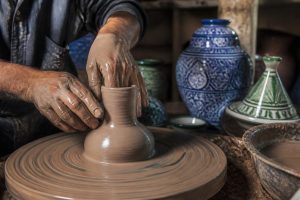
Pottery begins with local material that is prepared, kneaded and shaped. It may be hand-built, wheel-thrown, dried, decorated, glazed and then fired. Each stage influences the strength, colour and final use of the object. Products from Safi and Fez are known for their decorated ceramics, while many villages continue to produce utilitarian forms or preserve hand-modelling techniques.
In Tamegroute, in the Drâa Valley, workshops are notably known for green glazes whose shades are never perfectly identical. The result depends on the mineral composition and firing. It would, however, be misleading to reduce all local production to a single colour: shapes, decoration and finishes evolve, and not every object sold under this name necessarily comes from the village.
Before using a piece to cook or serve food, it is best to ask explicitly whether it is intended for food use and how it should be maintained. A decorative object does not automatically offer the same guarantees as tableware designed for repeated contact with food.
Zellige: decoration built piece by piece
Zellige is not a pattern printed on a tile. In its traditional form, glazed tiles are cut into small geometric pieces and then assembled face down according to a precise composition. The beauty of the result comes as much from the colour as from the rhythm between the shapes and the mastery of the whole.
This technique is closely associated with architecture: fountains, courtyards, walls, tables and decorative elements. Fez holds a major place in this art. Its creation requires several trades and great precision, from preparing the tile to installation. Contemporary designs reuse this vocabulary in new, sometimes highly minimalist formats. Innovation does not erase expertise; on the contrary, it can open up other uses for it, provided the material and the work required are respected.
Metalwork: repoussé, hammering and engraving
Metalwork refers to working with sheets of metals such as copper or brass. Trays, lanterns, frames, basins and household objects take shape through cutting, hammering, repoussé, chasing, engraving and assembly. Fez, Marrakech and Tetouan are among the cities where this expertise is particularly visible.
Highly elaborate decoration takes time, but the density of ornamentation is not the only measure of quality. The balance of the shape, clarity of the patterns, soldered joints, stability and surface finish must also be considered. Some pieces are deliberately contemporary and understated; they remain handcrafted if their production relies on these mastered techniques.
In 2023, UNESCO inscribed the arts, expertise and practices associated with engraving on metals—gold, silver and copper—in a multinational file in which Morocco participates. This recognition concerns communities and living practices; it does not turn every metal object sold in a souk into a certified heritage piece.
Leather and leather goods: several trades behind one object
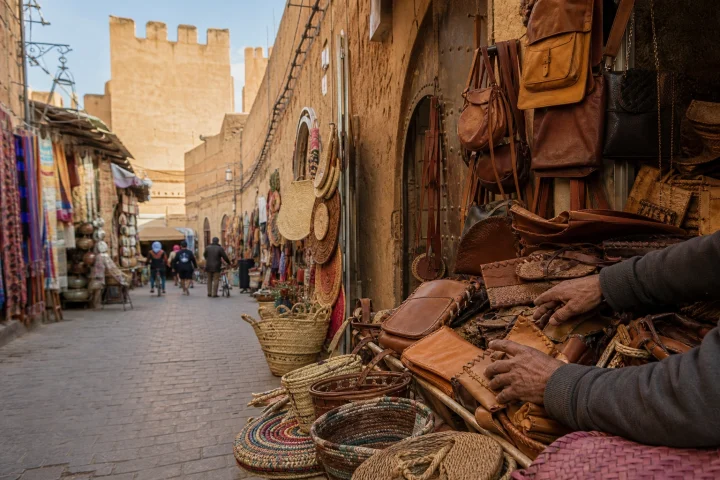
Between a raw hide and a pair of babouches, several operations follow one another: preparation, tanning, dyeing, drying, cutting, stitching and finishing. The tanneries of Fez are the best-known image of this industry, but leatherwork is practised in many cities. Bags, belts, pouffes and shoes may be made to very different standards of quality.
To assess a piece, you can examine the thickness and suppleness of the leather, the consistency of the stitching, the lining, fastenings and finish of the edges. A strong smell proves neither origin nor quality. The seller should be able to explain the type of leather, where it was made and the care precautions without inventing a story that is impossible to verify.
Embroidery, caftans and complementary trades
Moroccan embroidery also varies according to cities and workshop traditions. Rabat, Fez, Tetouan and Azemmour are associated with distinct repertoires and techniques. The design, choice of thread, stitch density and function of the piece—clothing, linen or decoration—shape the result.
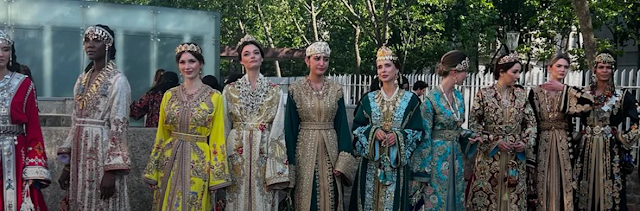
The caftan illustrates cooperation among several trades. Its creation may involve weavers, tailors, embroiderers and craftspeople who make braids and buttons. In 2025, UNESCO inscribed “The Moroccan caftan: art, traditions and skills” on the Representative List of the Intangible Cultural Heritage of Humanity. The inscription highlights both the garment and the chain of knowledge passed down through families, workshops and training programmes.
At the same time, the caftan continues to evolve. Designers and craftspeople modify cuts, materials and ornamentation, without any need to mechanically oppose tradition and modernity. The central question remains the quality of the work and recognition of the people who produce it.
Wood, thuya and ironwork: objects in dialogue with architecture
In Essaouira, thuya is associated with marquetry and small objects whose grain plays a full part in the decoration. Elsewhere, cedar, walnut and other woods are used for joinery and carving. It is worth asking about the origin of the wood and its sustainable management, because a beautiful finish alone reveals nothing about where the material came from.
Wrought iron appears in gates, lighting, furniture and architectural elements. The blacksmith heats, bends, assembles and finishes the material according to its intended use. As with engraved metal, a contemporary creation can continue the craft without exactly reproducing an old design.
Buying with discernment and respect
Courteous bargaining is part of many commercial situations, but it should not erase the hours of work involved. Before discussing the price, it is useful to understand the material, size, complexity and number of intermediaries. Comparing genuinely comparable objects avoids placing documented handmade production and an industrial product on the same level.
A few simple questions improve the purchase: was the piece made in this workshop? By whom? How long did it take to make? Is the material local? Is the object signed or accompanied by written information? For a substantial order, a detailed receipt and clear shipping terms are essential.
Photographing a craftsperson or their workshop requires their permission. A demonstration is not free entertainment: it involves time, a workspace and sometimes processes that the craftsperson does not wish to reveal. Buying directly, when the connection with the maker can be verified, can make the relationship more transparent.
A living heritage, not a static collection
Moroccan crafts endure because they still serve a purpose and because people choose to learn them. They face the cost of materials, competition from copies, remuneration, working conditions and the challenge of transmission. Tourism can support workshops, but it can also encourage standardisation if all buyers demand the same colours and shapes.
Viewing crafts as living heritage changes the way we travel. We no longer look only for “the” beautiful Moroccan object: we learn to recognise a region, a material, a sequence of techniques and one person’s creativity. It is this precision that gives a souvenir its depth—and craftsmanship the place it deserves.
Institutional sources
- Moroccan National Tourist Office, “The different products of Morocco’s traditional crafts”: https://www.visitmorocco.com/fr/decouvrir-le-maroc/artisanat-traditionnel-revisite
- Maison de l’Artisan, publications and statistics on product families: https://mda.gov.ma/fr/documentation-et-informations/ressources/publications-et-statistiques/
- UNESCO, “The Moroccan caftan: art, traditions and skills”, 2025 inscription: https://ich.unesco.org/fr/RL/le-caftan-marocain-art-traditions-et-savoir-faire-02077
- UNESCO, elements of Morocco’s intangible cultural heritage: https://ich.unesco.org/fr/etat/maroc-MA