The dispute surrounding the 2025 AFCON final and the US bond programme for certain visas have been conflated in many publications. Yet these are two cases with no direct legal connection: one falls under African sports justice and the Court of Arbitration for Sport, while the other concerns United States immigration policy.
Official documents make it possible to set the record straight. CAS did register the appeal by the Senegalese Football Federation on 25 March 2026. As of the date this article was checked, no final award has been published, and a hearing is listed on the calendar for 8 October 2026. US bonds, meanwhile, apply to certain B-1/B-2 visa applications depending on nationality and consular assessment; they are not a general fee imposed on all African supporters.
The sporting result of the final
On 18 January 2026, Senegal defeated Morocco 1-0 after extra time in the final of the Morocco 2025 Africa Cup of Nations. CAF then presented Senegal as African champions, with a goal by Pape Gueye.
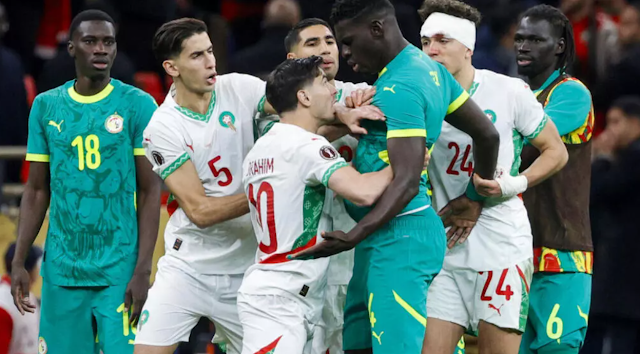
However, the match was marked by an interruption and the temporary departure of Senegalese players following a disputed refereeing decision. The Royal Moroccan Football Federation initiated proceedings before CAF’s disciplinary bodies.
A distinction must be made between the result achieved on the pitch, 1-0 to Senegal, and the subsequent disciplinary decisions. Both elements form part of the case’s chronology.
CAF’s decision of 17 March 2026
The CAF Appeal Board overturned a previous disciplinary decision on 17 March 2026. It found that the Senegalese team’s conduct fell under Articles 82 and 84 of the competition regulations.
CAF then declared that Senegal had forfeited the final and approved a 3-0 result in Morocco’s favour. This decision changed the legal attribution of the match at confederation level.
The official publication states that the FRMF’s appeal was found admissible and well-founded. It constitutes the decision being challenged before CAS.
CAS did register the Senegalese appeal
Contrary to claims made in some publications dated 25 March, the Court of Arbitration for Sport did not deny the existence of an appeal. Its official statement issued that same day instead announced the registration of the Senegalese Football Federation’s appeal against CAF and the FRMF.
The case bears the reference CAS 2026/A/12295. The FSF is seeking to have the CAF Appeal Board’s decision annulled and to be declared the winner of the competition.
The statement also indicates that the Senegalese federation had requested the suspension of the deadline for filing its appeal brief until it received notification of the full grounds for the contested decision.
Where does the procedure stand in August 2026?
The official CAS hearing calendar lists the case of FSF v. CAF and FRMF for 8 October 2026. As of 22 August, that hearing therefore still lies in the future.
No final award appears in the official publications consulted. It is impossible to announce today that CAS has definitively confirmed Morocco or restored the title to Senegal.
In the meantime, the decision published by the CAF Appeal Board remains the latest known official judicial act concerning the attribution of the match. CAS may subsequently uphold, amend or annul that decision based on its review of the case.
Fake documents that appeared online
In the summer of 2026, a document presented as a CAS decision circulated on social media. It awarded the title to Senegal under a reference different from that of the real case.
Checks identified several anomalies: an incorrect case number, incomplete parties and a format that did not match official communications. The correct number, CAS 2026/A/12295, remains the one announced in March and listed on the hearing calendar.
A viral image, even one bearing a logo, must therefore not be treated as an award. The CAS database, CAF statements and authenticated declarations from the federations are the sources that should be consulted.
No evidence of Algerian or South African involvement
The official CAS and CAF documents identify the parties to the proceedings: the Senegalese Football Federation, CAF and the Royal Moroccan Football Federation. They mention neither Algeria nor South Africa as parties or funders.
Claims that Algerian or South African intelligence services are seeking lawyers in Lausanne are not accompanied by any verifiable evidence in the documents consulted. They must not be presented as facts.
Political support, a media opinion or a rumour about funding does not amount to legal involvement. Without a document, an attributed statement or a reliable accounting record, the correct wording is: not established.
Why US visas are a separate matter
The US bond programme concerns the issuance of certain temporary B-1/B-2 visas. It is based on US immigration law and a list of nationalities published by the Department of State.
It depends neither on CAF, nor on CAS, nor on the result of the final. Linking it to the sports appeal may create the impression of a coordinated sanction against certain African teams, which the official documents do not show.
Supporters must examine the rules corresponding to their nationality and individual circumstances, not their federation’s position in sports proceedings.
Which countries are on the bond list?
The Department of State page updated on 13 May 2026 lists the nationalities concerned and the date they entered the programme. Algeria and Senegal have been included since 21 January 2026; Tunisia since 2 April.
Côte d’Ivoire and Cabo Verde also appear on the list. As of that date, Morocco and South Africa do not appear on it.
The list may change. It should be consulted directly before applying for a visa rather than copying an old table or assuming that every country on a continent is affected.
The amounts do not depend on age
The US framework provides for three possible amounts: 5,000, 10,000 or 15,000 dollars. The amount is determined by the consular officer based on the application; the text does not set a bond of 10,000 to 15,000 dollars for each adult and 5,000 dollars for each child.
The bond replaces neither the visa fees nor the eligibility assessment. It applies when an applicant covered by the programme is otherwise found eligible and is instructed to post it through the official channel.
Beware of intermediaries who promise to obtain a reduced bond or request payment outside the government procedure.
Under what conditions is the bond refunded?
The bond is intended to guarantee compliance with the conditions of stay. It may be released when the traveller leaves the United States within the authorised period and the departure is properly recorded, or in other situations provided for by the procedure.
The refund period must not be promised as automatically taking two weeks. It depends on confirmation of departure, administrative processing and the payment method.
Overstaying or certain changes of status may result in a breach of the bond conditions. For an individual case, only the Department of State, the Department of Homeland Security or qualified legal counsel can provide an appropriate answer.
Exemptions related to the 2026 World Cup
The Department of State has announced a bond exemption for certain World Cup participants who are nationals of qualified countries: players, coaches, people performing a necessary support role and members of their immediate families, provided they meet the other visa requirements.
An exemption is also provided for certain ticket holders who are nationals of participating countries, had purchased their tickets before 15 April and selected the FIFA PASS priority appointment system, while remaining eligible for a visa.
This is therefore neither a general exemption for all African delegations nor the removal of consular checks. Each application remains subject to the assessment required under US law.
What supporters must check
Before incurring expenses, a supporter must check whether their nationality appears on the list, which consulate handles their application, which processing times apply and whether they may meet the conditions for a World Cup-related exemption.
Never purchase non-refundable travel solely on the basis of a visa appointment or a rumour of an exemption. A match ticket does not guarantee entry into the United States.
Official pages may be changed quickly. The date of consultation is therefore as important as the content of the rule.
Two cases, the same need for verification
The FSF’s appeal is real, registered and still pending. The hearing announced for 8 October 2026 means that any verdict presented as final before that stage must be checked with particular caution.
The US bond programme is also real, but its amounts are not divided between adults and children, and its exemptions are precisely defined. It does not prove any manoeuvring related to the sports dispute.
In both cases, the method is the same: identify the original document, check its date, distinguish an ongoing procedure from a final decision and refuse to attribute intentions to countries without published evidence.
Institutional sources
- CAF, sporting result of the Senegal–Morocco final of 18 January 2026: https://www.cafonline.com/fr/can2025/infos/le-senegal-encore-sur-le-toit-de-l-afrique-apres-la-victoire-sur-le-maroc-en-finale-de-la-totalenergies-caf-can-2025/
- CAF, Appeal Board decision of 17 March 2026: https://www.cafonline.com/fr/infos/declaration-aux-medias-du-jury-d-appel-de-la-caf/
- Court of Arbitration for Sport, registration of the FSF appeal on 25 March 2026: https://www.tas-cas.org/generated/assets/lists/dceab111-07bc-435f-b5f9-de88eff9db72/CAS%20Media%20Release_12295_appel_FR.pdf
- Court of Arbitration for Sport, hearing calendar and case CAS 2026/A/12295: https://www.tas-cas.org/en/news/List-of-Hearings
- US Department of State, countries subject to visa bonds and World Cup exemptions: https://travel.state.gov/content/travel/en/News/visas-news/countries-subject-to-visa-bonds.html
- Federal Register, temporary Visa Bond Pilot Program framework and possible amounts: https://public-inspection.federalregister.gov/2025-14826.pdf