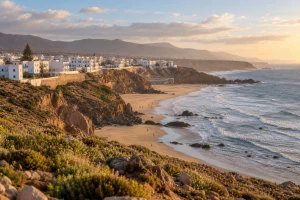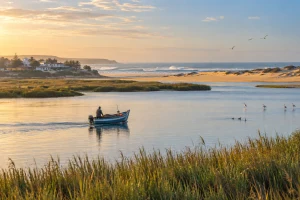
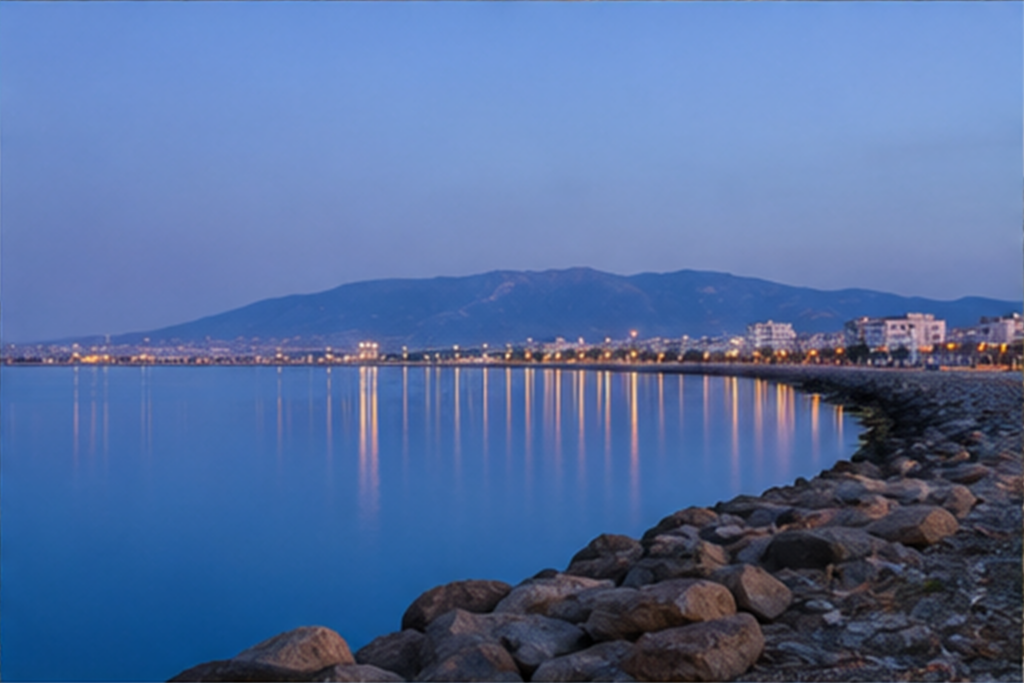
Nador stretches along Marchica, a vast Mediterranean lagoon that shapes the landscape, activities and development projects in the area. The city is sometimes treated as simply an arrival point for other beaches; yet it deserves a stopover combining the waterfront, markets, lagoon environment and nearby landscapes.
When planning, distinguish between what can be done on foot in the city, what requires a vehicle and what depends on access or an operator. Marchica is not a uniform park: the shores, ports, developed areas and sensitive spaces cannot all be visited in the same way.
Getting to Nador
Nador El Aroui Airport is located outside the city. Check the schedule with ONDA and arrange your transfer before a late arrival. Ask for the total price and meeting point.
The train connects Nador to the national network, with connections depending on the point of origin. Coaches provide additional options. Check the official timetable rather than an old schedule and note the exact terminal.
The port of Beni Ansar also handles maritime connections. Formalities, schedules and disembarkation times may affect your arrival. Keep your documents accessible and consult our guide to formalities for Morocco
Understanding Marchica Lagoon
Marchica is separated from the Mediterranean by a coastal strip and is connected to the sea. This geography creates important wetlands and explains the presence of birds, fishing activities and development projects.
An urban walk reveals part of the lagoon, not all of it. To explore it further, request an itinerary specifying the stopping points, authorised access points and means of transport.
Do not walk through a vegetated area simply because no barrier is visible. Mudflats and banks can be fragile. Use existing promenades and observation points.
Exploring the corniche and city centre
The corniche offers an initial introduction without complex logistics. Choose the morning or late afternoon for pleasant light and milder temperatures. Observe local life without turning every scene into a photograph.
The centre and markets place Nador within the economic life of the Oriental region. Ask prices before making a purchase, keep small notes and respect people at work.
For meals, look for available produce and an establishment where hygiene appears clear. Fish and seafood must be stored correctly; proximity to the lagoon alone does not guarantee freshness.
Watching birds without disturbing them
A lagoon attracts resident and migratory birds, but species and numbers vary by season. Bring binoculars and accept the uncertainty. A promise of seeing a specific animal should be treated with caution.
Keep your distance, remain quiet and do not walk through a group to make it take flight. Do not share the exact location of a nest. A nature guide can explain the environment without seeking excessive proximity.
Photography with a telephoto lens is preferable to approaching. Drones bring additional noise and regulations; they must not be used without authorisation.
Connecting Nador with nearby beaches
The beaches along the eastern coast do not all have the same conditions. Check access, lifeguard supervision, wind and water quality with recent local sources. An isolated beach requires an organised return journey.
Bring water, sun protection and shoes if the shore is rocky. Leave neither plastic nor cigarette butts behind. If there is no waste collection, take your rubbish back to the city.
Avoid driving onto sand or dunes. Tyre tracks compact the ground, disturb vegetation and may inconvenience other visitors.
Going up Gourougou with care
The Gourougou massif overlooks the region and offers viewpoints. Roads and paths require up-to-date information, particularly after rain or roadworks. Do not blindly follow a shortcut suggested by an app.
Set out during daylight, share your itinerary and bring water. A local guide is recommended for a walk away from the obvious routes. Keep your distance from wild animals and do not feed them.
A viewpoint does not justify stopping dangerously on the road. Park only in a place that blocks neither local residents nor emergency services.
Arranging a boat trip
If a lagoon or sea excursion is offered, identify the operator and the boat. Ask about capacity, life jackets, means of communication, duration and weather-related decisions. The skipper must be able to alter the trip if conditions change.
The route must respect fishing and protected areas. Do not ask to enter a shallow area or chase birds for a photograph.
The price must include the stated fees. A substantial booking warrants written confirmation and an understandable cancellation policy.
Planning a three-day stopover
The first day can be devoted to the centre, the corniche and a meal near the waterfront. The second is suitable for a guided exploration of the lagoon or a beach visit, depending on the season.
The third day allows time for Gourougou or another regional excursion, returning before nightfall. In the event of wind or rain, replace the nature activity with time in the city rather than forcing the itinerary.
With more days, connect Nador with other stops in the Oriental region by staying overnight. Long return trips reduce observation time and increase fatigue.
Accommodation and local transport
Choose accommodation according to your actual base: proximity to the corniche, the station or vehicle access. Check noise, parking and lift access. An address described as “near Marchica” may still be far from the intended place of interest.
Small taxis serve urban journeys; for an excursion, agree on the price and return trip. A car offers flexibility but adds driving, parking and navigation.
For a person with reduced mobility, request measurements and photographs. The Accessible Morocco guide provides useful questions.
Nador–Marchica checklist
- Exact airport, station or port identified.
- Arrival transfer confirmed in writing.
- Authorised access to shores and beaches checked.
- Binoculars used instead of approaching wildlife.
- Marine weather forecast checked before the boat trip.
- Return journey arranged from isolated areas.
- Waste taken away when no collection is available.
- Time set aside for the city, not only for excursions.
Sources consulted
- Moroccan National Tourist Office, Morocco destination and geography: https://www.visitmorocco.com/en/discover-morocco/geography-morocco
- Moroccan National Tourist Office, brochure on sustainable Morocco and Marchica: https://www.visitmorocco.com/sites/default/files/atoms/files/maroc_durable_0810_pbi251101-en_1.pdf
- National Airports Office, Nador El Aroui Airport: https://www.onda.ma/
- ONCF, timetables and booking: https://www.oncf-voyages.ma/
- National Agency for Water and Forests: https://www.eauxetforets.gov.ma/