Embroidery may first attract attention through colour, but its richness appears when the viewer slows down. Design organises the cloth, thread builds texture and regularity reveals long practice. In Rabat, this skill belongs to a history of workshops, clothing and domestic decoration.
Morocco’s national tourism office names Rabati embroidery among the city’s crafts and refers to cotton, linen, chiffon and brocade as possible supports. Uses range from caftans to furnishing textiles. That diversity is a reason to understand function before judging the object.
Begin with the motif
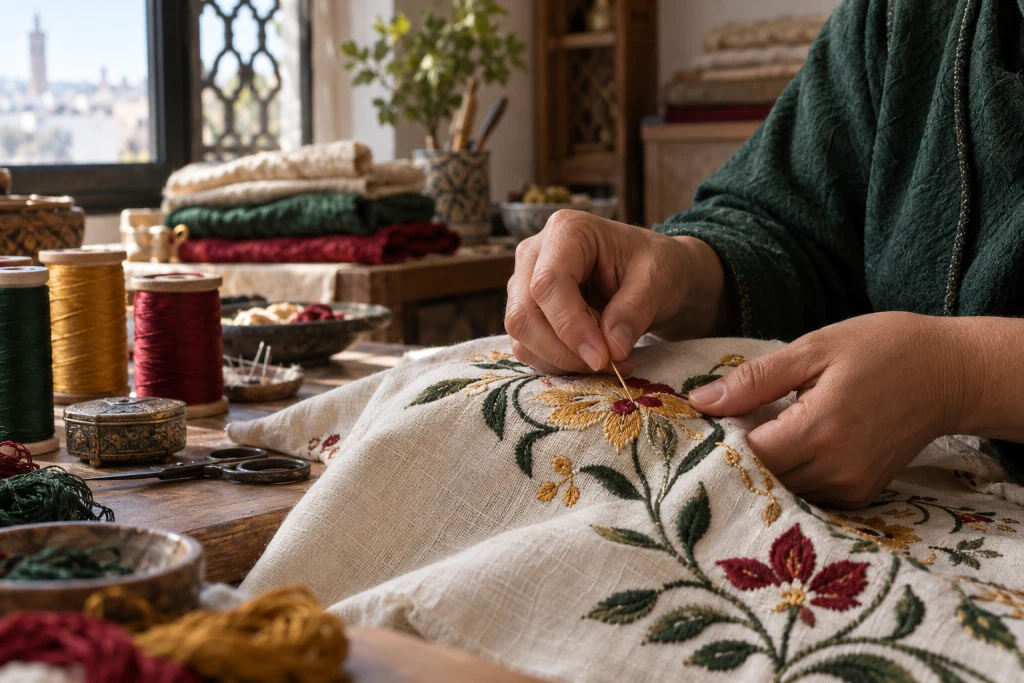
A motif is more than decorative filling. It creates rhythm, organises empty space and leads the eye across the surface. Floral compositions documented by UNESCO show how coloured silk thread can structure a piece with precision.
Notice repetition, symmetry and changes of scale. Ask whether the design was transmitted, adapted or created for a commission. The answer may reveal as much about the workshop as the visible result.
The fabric changes the gesture
Working on linen, cotton, chiffon or brocade does not create the same tension or finish. The support influences thread choice, motif density, flexibility and the object’s eventual use.
Embroidery for clothing should not be read in the same way as a panel or cushion. Before buying, ask about the fabric, care and assembly. These details prevent quality from being reduced to the amount of stitching alone.
Looking at the front and reverse
With the maker’s or seller’s permission, the reverse can help explain stops, thread paths and construction. It is not a universal authenticity test and cannot establish the story of a piece in a few seconds.
Quality depends on the project, function and technique. A regular finish may be the goal, while an older or repaired textile carries different traces. Ask open questions instead of applying a rule learned from a photograph.
Transmission takes place in several settings
UNESCO states that skills associated with the Moroccan caftan are passed on through families, workshops and formal schools. The element inscribed in 2025 brings together several professions, including embroidery artisans.
The inscription concerns the Moroccan caftan, its art, traditions and skills; it does not mean that every piece of Rabat embroidery holds a separate UNESCO status. That distinction protects both accurate information and the actual value of the work.
Meet a maker without staging the encounter
A demonstration takes time and concentration. In a workshop, ask before photographing hands, a face, a design or a commission in progress. A composition may belong to a customer or form part of the maker’s own creative work.
Purchasing does not automatically grant permission to film. A considered conversation about motif, material and use often creates a more lasting memory than footage made without an exchange.
Choose a piece thoughtfully
Begin with the intended use: clothing, household textile, gift or framed work. Then confirm the material, dimensions, stated production time and care instructions. For a commission, have the design, colours, deadline and total price specified.
Avoid absolute claims such as entirely handmade or ancient motif when nobody can explain the production. Documented origin and an honest description are more valuable than prestigious language that cannot be verified.
Repairs and transformations matter
A textile can be altered, repaired or passed on. Asking whether embroidery can be restored changes the relationship with the object: it brings longevity, specialist skill and future adaptation into the decision.
This attention also recognises work that is usually invisible. Value lies not only in the moment of purchase but in an object’s ability to be worn, maintained and described accurately over time.
Take home a well-attributed story
Note the workshop name if the maker wishes, the fabric and what was explained. Do not invent symbolism to make the story more attractive. A motif may carry a precise history, reflect personal inspiration or simply answer a chosen composition.
Rabat embroidery is discovered in layers: first colour, then structure, and finally transmission. Looking slowly makes it possible to leave with a better-understood object and a memory of a living skill.