Moroccan gardens are not merely settings of zellige and orange trees. They organise water, shade, fruit production, walking and sometimes the representation of power. Their form depends on their scale: the intimate courtyard of a house, a walled orchard, a large royal reservoir, an urban park or a contemporary botanical creation.
Visiting them with this framework in mind avoids reducing very different places to the term “Oriental garden”. An agdal covering several hectares, a riad patio and a garden designed in the 20th century have neither the same history nor the same use.
Water shapes the space
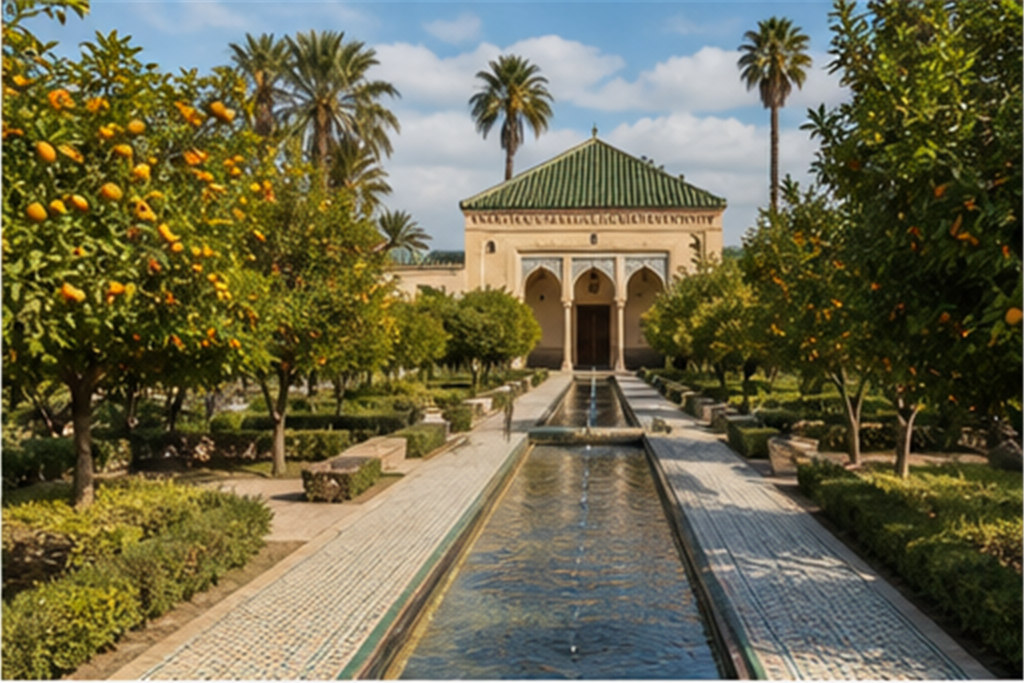
In a climate where water is precious, canals, basins and fountains fulfil several functions. They distribute irrigation water, cool the air, reflect the architecture and give rhythm to the route. Their presence requires water collection, storage, a gradient and maintenance.
A monumental basin is not necessarily intended for bathing. Respect the barriers and do not throw anything into it. During periods of restrictions, a fountain that is not running does not mean that the site has been abandoned.
Morocco is currently developing desalination, interconnections and reuse in response to water stress. This contemporary reality encourages visitors to view a garden as a resource system, not as an eternally green image.
The agdal, a protected orchard-garden
The term agdal refers to the idea of a protected or reserved space and may denote large irrigated orchards. In Marrakesh, the Agdal Gardens are part of the property inscribed by UNESCO together with the medina.
Olive trees, citrus trees and other trees combine production, shade and landscape. The large basins contribute to storage and irrigation. Geometry therefore serves function as much as aesthetics.
Access may vary depending on works, opening hours and management. Check with the authorities or your accommodation before making a detour, and do not enter through an unmarked opening.
The Menara, a landscape of water and the Atlas
The Menara brings together a vast basin, an olive grove and a pavilion, with the High Atlas in the background when the air is clear. This famous view should not overshadow the hydraulic role of the complex.
Come early to walk in cooler and less crowded conditions. The distances around the basin are greater than a frontal photograph suggests. Bring water and sun protection.
The site is a place frequented by residents as much as it is a monument. Do not block the paths for a photo shoot, and respect the cultivated areas.
The riad’s inner garden
A riad is built around an inner garden, often laid out along axes. The walls create shade, privacy and protection from the street. Water, vegetation and architecture create a microclimate.
Many guesthouses now use the word riad, sometimes for a residence without a garden. This commercial development should not obscure the architectural distinction from the dar, which is organised around a courtyard.
If you stay in a historic house, ask about its history without assuming that everything is old. Restorations, modern utilities and safety adaptations are part of its present-day life.
Orange trees, olive trees and useful plants
The orange tree combines fragrance, shade, fruit and evergreen foliage. The olive tree withstands drier conditions and structures many orchards. Date palms, pomegranate trees, fig trees, jasmine and aromatic plants appear depending on the region.
A plant presented as “typically Moroccan” may have circulated between continents for a long time. Gardens are precisely places of botanical exchange, acclimatisation and selection.
Do not pick fruit or flowers without permission. Even in a free park, harvesting may be reserved for maintenance staff or an agricultural operation.
Andalusian gardens and shared legacies
Geometric forms, canals and patios bear witness to longstanding exchanges between the Maghreb and the Iberian Peninsula. Referring to an Andalusian legacy is relevant, provided that every fountain is not attributed to a single model.
In Fez, Marrakesh, Rabat and Meknes, gardens have changed under several dynasties and during different periods of urban development. A contemporary restoration also selects a particular historical state and particular uses.
To place these cities in their chronology, see our guide to the imperial cities of Morocco
20th- and 21st-century creations
The Majorelle Garden in Marrakesh is a modern creation combining a botanical collection, colourful architecture and artistic history. Other contemporary gardens explore adapted species, art and walking.
They should not be described as medieval survivals. Their appeal comes from choices of composition, collection and conservation specific to their time.
Book when the site requires a time slot, and use only the official channel. A platform that resells a ticket with a significant surcharge must clearly state its role.
Visiting without wasting or causing damage
Stay on the paths, do not climb onto borders and do not touch the irrigation systems. A lawn closed to the public may be fragile even if it looks robust.
Keep your bottle and rubbish with you. A historic garden is not intended to accommodate picnics everywhere. Look for designated areas, and avoid feeding birds or cats.
The heat can make a site difficult to visit in the middle of the day. Visiting early protects the traveller and reduces the need to demand more water or air conditioning along the route.
Photographing the garden differently
Look at the traces of water flow, variations in shade, the textures of the plasterwork and the relationship between productive trees and architecture. A general view tells only part of the story of the place.
Avoid long sessions that monopolise an axis or doorway. Ask for permission to use a tripod, carry out a commercial production or fly a drone.
When posting, name the garden and its period rather than calling it a “secret palace”. An accurate caption aids understanding and helps distribute visits.
A thematic itinerary in Marrakesh
A day can begin at the Menara, continue in a medina garden and end in a modern creation. Do not try to add every palace: the distances, queues and heat would reduce the time available for observation.
A second day allows for the Agdal if access is confirmed, followed by an exploration of historic patios. Always check the latest opening hours, as gardens and monuments may close for maintenance.
To prepare for urban transport and expenses, our guides to transport in Morocco and money in Morocco complement the itinerary.
Sources consulted
- UNESCO, Medina of Marrakesh and Agdal Gardens: https://whc.unesco.org/en/list/331/
- Moroccan National Tourist Office, Marrakesh: https://www.visitmorocco.com/en/travel/marrakech
- Official Majorelle Garden website: https://www.jardinmajorelle.com/
- Ministry of Youth, Culture and Communication: https://mjcc.gov.ma/
- Official Maroc.ma portal, water policy: https://www.maroc.ma/fr/actualites/la-politique-des-barrages-levier-strategique-de-la-resilience-hydrique-et-de-la-justice-territoriale-m