In tourist descriptions, “riad,” “dar,” “kasbah” and “ksar” sometimes become synonyms for charming accommodation. Yet they refer to different forms, scales and functions. Understanding them helps you interpret a medina, a fortified village or a southern valley.
These categories are not rigid boxes. A building may change use, undergo extensions or be given a commercial name. It is important to distinguish between the architectural term, local history and the way the accommodation presents itself today.
This distinction makes each visit easier to understand and avoids passing on commercial legends as historical definitions.
The dar, a house arranged around a courtyard
Dar means house. In many medinas, the dwelling is arranged around an inner courtyard that provides light, ventilation and privacy. The street-facing façade may remain understated, while decoration is concentrated inside.
The rooms open onto the courtyard rather than the public space. This principle responds to urban density, the climate and family uses. Upper floors and terraces complete the layout.
A guesthouse called a dar may be authentic while also having been fitted with bathrooms, utilities and modern standards. Ask about the date and nature of the restoration.
The riad and its inner garden
In the architectural sense, a riad is distinguished by an inner garden, often divided along axes and associated with a fountain or pool. Plants therefore play a structural role, beyond that of a simple paved courtyard.
In the hotel industry, the word riad is widely used for traditional houses in the medina, even without a complete garden. This shift is not automatically fraudulent, but travellers should read the specific description.
Our article on Moroccan gardens explains the role of water, shade and planting in these spaces.
The kasbah, a fortified building
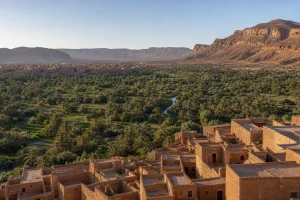
Depending on the region and period, kasbah may refer to an urban citadel, a fortified residence or a complex associated with power. In the south, the word is often associated with large earthen houses with towers.
A kasbah is therefore not simply an ochre-coloured house. Its location, defences, owner and functions must be studied locally.
Some have been restored as hotels; others remain fragile or partially inhabited. Never enter an unsecured ruin to get a view.
The ksar, a fortified grouped settlement
A ksar is a village or group of dwellings within an enclosure. It may include lanes, houses, communal spaces, granaries and religious buildings.
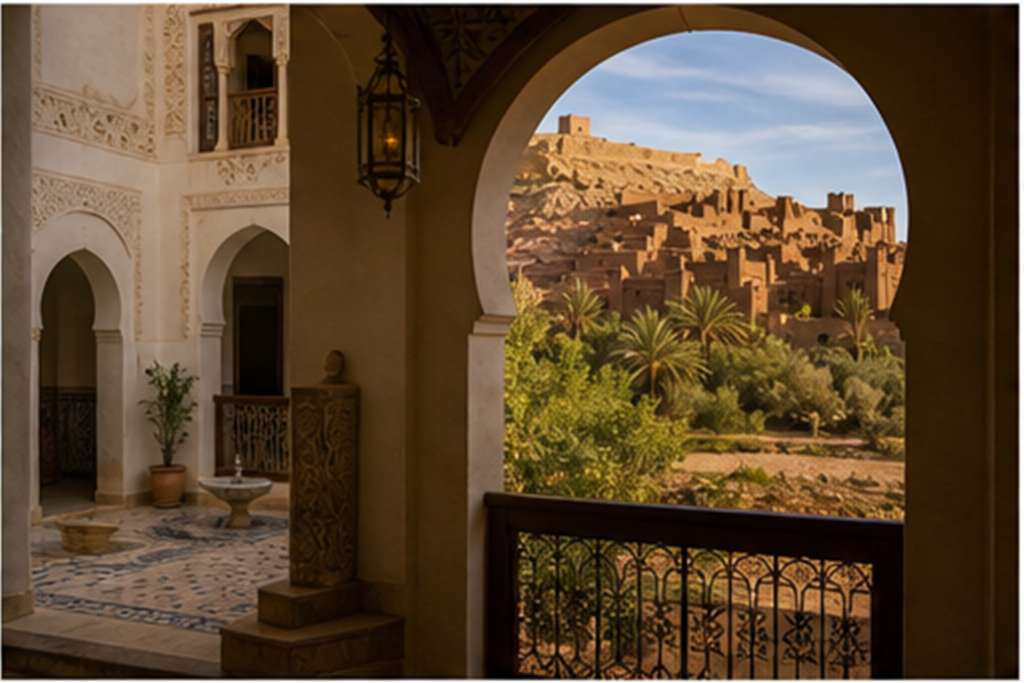
Aït-Ben-Haddou is a World Heritage-listed example. Calling it a “kasbah” erases its collective scale, even though fortified buildings are found inside.
The guide visiting Aït-Ben-Haddou covers raw earth, conservation and respect for residents.
Earth, stone, wood and lime
Materials reflect the region. Raw earth dominates many pre-Saharan landscapes; stone and wood play other roles in the mountains; brick, lime, plaster and ceramics appear in cities.
A rammed-earth wall is made from earth compacted in formwork. Adobe uses dried earth bricks. Repairs require compatible materials: impermeable cement can trap moisture.
An irregular appearance is not a flaw to be smoothed over. It reflects a technique that requires maintenance, rendering and expertise.
Zellige, plaster and carved wood
In affluent urban residences, zellige, carved plaster and painted or chiselled wood form decorative ensembles. Their arrangement follows hierarchies of space, cost and display.
Not all decoration visible today is old. Contemporary craftspeople restore or create pieces using historical techniques. A new piece can be remarkable if it is presented honestly.
Do not touch the reliefs or lean against a painted panel. Flash photography, tripods and commercial shoots may be regulated.
Privacy, thresholds and circulation
The angled entrance of many houses limits the direct view from the street. Thresholds organise movement between public areas, guests, family and services. This logic explains the understated façade and richly decorated interior.
In an occupied house, an open door does not make the courtyard public. Ask before entering or taking photographs. A guide does not have the right to improvise a visit to a neighbour’s home.
Terraces sometimes adjoin one another, but they remain private. Do not cross from one roof to another without an explicitly authorised route.
Converting a house into accommodation
Creating a hotel in an old residence requires plumbing, electricity, fire safety, ventilation and evacuation routes. These interventions may preserve, alter or sometimes weaken the building.
Ask whether the room is accessible by stairs, whether the courtyard is noisy and whether the terrace has a safety barrier. Charm is no substitute for safety or an accurate description.
For mobility needs, our accessible Morocco guide provides a checklist of measurements and photographs to request.
Interpreting a restoration
Look for differences in texture, old photographs and explanations of the work. A restoration may preserve traces, reconstruct a missing section or adapt the use.
The best projects indicate what is original, restored and added. A single date such as “built in the 17th century” does not mean that every wall dates from that period.
Supporting a well-maintained site contributes to passing on this heritage, provided that the craftspeople are identified and residents are not excluded from the story being told.
A short visitor’s glossary
- Dar: house, often arranged around a courtyard.
- Riad: house with an inner garden, in its architectural sense.
- Kasbah: citadel or fortified building, depending on the context.
- Ksar: fortified grouped settlement.
- Rammed earth: earth compacted in formwork.
- Adobe: dried raw-earth brick.
- Zellige: composition of cut ceramic pieces.
- Patio or courtyard: open interior space, not always planted.
Sources consulted
- UNESCO, Ksar of Aït-Ben-Haddou: https://whc.unesco.org/en/list/444/
- UNESCO, Medina of Fez: https://whc.unesco.org/en/list/170/
- UNESCO, Medina of Marrakesh: https://whc.unesco.org/en/list/331/
- Ministry of Youth, Culture and Communication: https://mjcc.gov.ma/
- Moroccan National Tourist Office, medinas and heritage: https://www.visitmorocco.com/en/travel/destinations