Volubilis and Moulay Idriss Zerhoun are geographically close and deeply connected by history, but they do not form a single attraction. The former is a World Heritage archaeological site; the latter is a living town and a major spiritual centre.
Visiting both on the same day from Meknes is possible if you avoid a succession of quick photos. A qualified guide, good shoes and a respectful attitude will help you understand the territory’s Mauretanian, Roman, Christian and Arab-Islamic layers.
Placing Volubilis within a long history
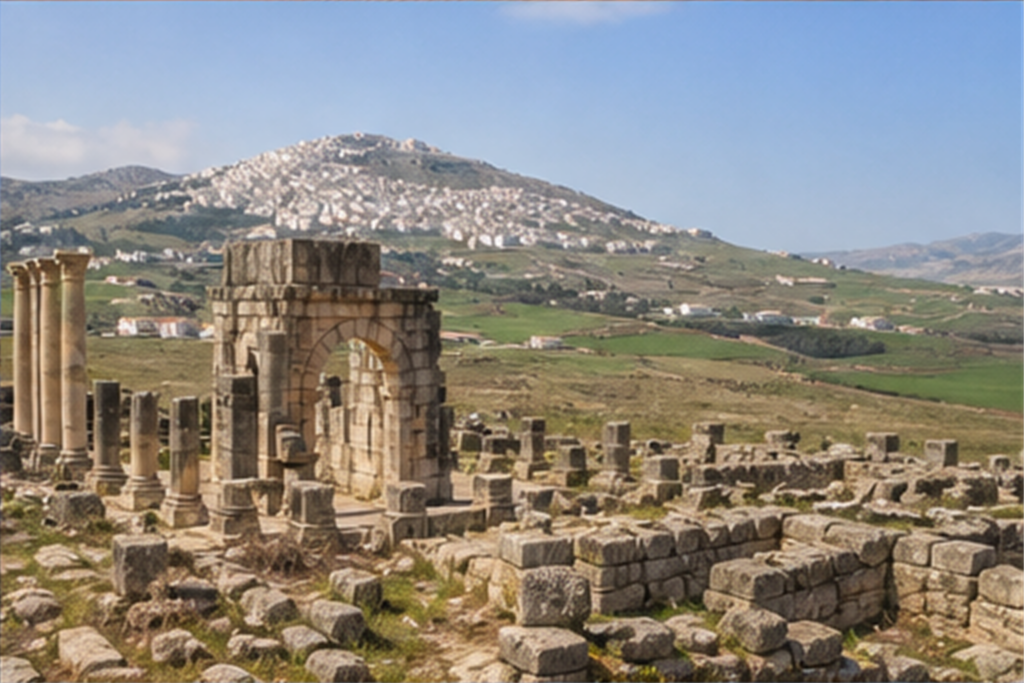
UNESCO describes Volubilis as a Mauretanian capital founded in the 3rd century BC, which became an important Roman outpost. Its remains bear witness to exchanges between local cultures and the Mediterranean world.
After the Roman period, the town did not disappear immediately. It is associated with Idris I, founder of the Idrisid dynasty, before the centre of power shifted elsewhere. This continuity means the site should not be presented as a “Roman” enclave isolated from Morocco.
A guided tour should distinguish established facts, archaeological hypotheses and legends. Ask about the guide’s qualifications and compare their explanations with the site’s information panels.
Reaching the site from Meknes
Volubilis lies at the foot of Jebel Zerhoun. From Meknes, the usual options are a taxi, a private driver or an organised excursion; confirm whether it is private or shared, the return fare and the waiting time.
If the driver does not stay, agree on the place and time for the return journey. Do not assume that network coverage and transport availability will be the same as in a city centre. Keep the number of your accommodation or a backup taxi.
A hire car provides freedom, but the driver should avoid combining driving, heat and an excessively long day of walking. See our guide to driving in Morocco
Visiting Volubilis at the right time
The site is largely exposed. In the hot season, arrive when it opens or late in the day, depending on official opening hours. Bring water, a hat and sun protection; shade is limited.
Allow at least two hours to explore the remains without rushing. The arch, capitol, basilica, oil presses and mosaics each illustrate different functions. Do not climb on a wall or touch a mosaic for a photo.
The paths are uneven. A person with reduced mobility should ask about access conditions and available options before departure. The terrain may remain difficult despite the nearby car park.
Understanding the mosaics without damaging them
The mosaics preserved in situ are both one of the site’s strengths and a source of fragility. Observe them from the designated areas, without crossing a rope or placing a bag on the tesserae. Zooming in replaces that extra step.
Low-angle light can sometimes help reveal the patterns. A guide can explain the function of the houses and the scenes depicted, provided they do not turn every image into a story presented as certain.
Do not pick up any fragments, however ordinary they may seem. A displaced stone loses its archaeological context, and the accumulation of small removals destroys the site.
Understanding Moulay Idriss Zerhoun
The town is named after Idris I, whose mausoleum is a place of pilgrimage. It is built on two hills and has a dense layout. Visitors must distinguish between public spaces, residential lanes and religious sites with regulated access.
The square, viewpoints and streets make respectful exploration possible without forcing entry into a sanctuary. Rules may change; follow signs and local guidance.
Appropriate clothing and discreet behaviour are necessary. Ask before photographing a person, a ceremony or the interior of a place.
Walking without intruding on daily life
The lanes are narrow and residential. Stay in a small group, speak quietly and do not block a doorway to frame a photo. A viewpoint is not a public terrace if reaching it means crossing private property.
A local guide can explain the town and facilitate exchanges, but check the price and duration before setting off. Refuse a tour that promises entry where access is not permitted.
Shop and eat without demanding a staged experience. Seasonal produce, breads and local specialities provide a more tangible connection than generic souvenirs.
Choosing the order of the day
In very hot weather, begin with Volubilis as soon as it opens, then continue to Moulay Idriss for lunch and walk later. In the cooler season, the order can be reversed depending on the light and opening hours.
Do not fit both visits between two other monuments in Meknes. A full day gives meaning to the historical connection and leaves time for a break. With a child, reduce the time spent in the sun and plan a simple activity.
Spending a night in Moulay Idriss allows you to experience the town after the excursions have departed. However, check access to the accommodation and the distance you will need to cover with luggage.
Hiring a useful guide
Ask whether the guide is authorised, which languages they speak and whether they cover both sites. The price should specify transport, admission and lunch. A driver is not automatically a tour guide.
A good guide adapts the level of explanation, points out what is uncertain and protects the site. They do not invite you to cross a boundary for a better photo.
For an online booking, identify the company that will actually provide the service. Keep the affiliation and cancellation conditions clear; a high rating is no substitute for a precise description.
Budget and practical preparation
Budget for return transport, the site ticket, a guide, lunch and water. Prices and opening hours must be confirmed through official channels or on site. Carry cash without taking an excessive amount.
Download a map and read an introduction to the site before arriving. You can then devote your time with the guide to questions rather than basic dates.
For payments and withdrawals, see our guide to money in Morocco
Heritage checklist
- Return transport confirmed before departure.
- Water, hat and sturdy shoes.
- At least two hours planned at Volubilis.
- No walking on walls or mosaics.
- Religious access checked and signs respected.
- Permission requested before taking portraits.
- Guide and driver distinguished in the price.
- Itinerary limited to Volubilis and Moulay Idriss.
Sources consulted
- UNESCO, Archaeological Site of Volubilis: https://whc.unesco.org/en/list/836/
- UNESCO, Morocco and the tentative listing of Moulay Idriss Zerhoun: https://whc.unesco.org/fr/etatsparties/ma
- Moroccan National Tourist Office, Meknes, Moulay Idriss and Volubilis: https://www.visitmorocco.com/en/travel/meknes
- Ministry of Youth, Culture and Communication, heritage: https://mjcc.gov.ma/